AGE OF MACHINES: THE LEARNING PROBLEM

KEY TAKEAWAYS
The cheapest robot training data is turning out to be some of the most valuable. In a Georgia Tech and Stanford study, a model trained on two hours of robot teleoperation plus one hour of someone filming their own hands scored 128 on a task, against 74 for a standard model trained on three hours of robot data. Xiaomi's newest model learned from 100,000 hours of handheld gripper footage, was aligned on 7,200 hours of robot data, and then needed under ten hours of robot time for each new task. What's scarce is variety, and variety comes from people.
No one agrees yet on how to train a robot. Some labs map camera pixels straight to motor commands, some teach models physics from video, and some let robots practise in simulation millions of times. NVIDIA is working on all three. Each of them still learns from people showing a machine what to do, so the data is a safer bet than any one model.
AI labs spend billions on human data, but almost all of it is words. The boom has been built on people writing, ranking and correcting model answers, and Meta paid $14.3B for 49% of Scale AI on the back of it. A robot needs something else: recordings of hands and arms moving through a task, with every joint angle, grip and push logged. The world's entire supply of that comes to around 300,000 hours, about 34 years of footage. Reading the text today's language models trained on would take a person roughly 100,000 years, which leaves robots with well under 1% of the experience language models learned from.
Robot data is sold by the hour, so the buyer pays for every failed take. Throwing away a bad text label costs pennies. Throwing away a bad robot recording wastes an hour of a robot, its operator and the lab it runs in. At a 55% acceptance rate, almost half the hours a buyer pays for end up unusable.
Traditional data collection usually grows one country at a time; open networks can collect from almost anywhere at once. A vendor or in-house team typically has to set up an entity, sign contracts and run payroll in each new market before a single task is recorded, so collection tends to cluster where it already operates. An open network only asks contributors for a browser and a wallet. Axis has drawn hundreds of thousands of contributors this way, and their data has already outperformed an established academic dataset of the same size.
EXECUTIVE SUMMARY
Language models learned from an internet that already existed. Robots have no equivalent store of the recorded actions and contact forces that turn a video of a task into a machine that can perform it. Bessemer puts the world's entire supply of robot manipulation data at roughly 300,000 hours, and robotics companies are now spending billions to add to it.
The vendors moving fastest to meet that demand are the ones that sold human data to AI labs through the language boom. Scale AI, valued at $29B by Meta's investment in 2025, now runs a physical AI data business, and like its peers it bills by the hour or the head. In robotics, that model leaves the buyer paying a full robot-hour for every rejected attempt. Four open networks (Axis, BitRobot, Eastworlds and THOR) are building a different supply model, each in its own way using open data and crypto incentives to reach contributors and environments that vendors do not.
Axis is the furthest along. More than 220,000 contributors have driven simulated robots through everyday tasks in a web browser, and in a paper accepted at an IROS 2026 workshop, a model trained on their data outperformed one trained on an established academic dataset of the same size. It is the only head-to-head test of data quality published by any of the four. Booster Robotics, a humanoid robot maker, has signed on as Axis's first commercial partner.
This report covers the three training approaches labs are stacking (vision-language-action models, world models, and simulation with reinforcement learning), the six data types they draw on, and the vendors moving in from language data. It then profiles Axis in depth, with BitRobot, Eastworlds and THOR as notable mentions, and closes with scenarios for how much robotics data spend open networks could capture.
1. ROBOTICS MODEL TRAINING
Humans spend more of their time on physical labour than on anything we create with our knowledge and creativity. Manufacturing, logistics, construction, agriculture, food preparation and the list keeps going. This work has to be done, and people spend their working lives on it. A person can move boxes, fold clothes, cook a meal, clear a table, fix a pipe, and switch between all of these in an afternoon without being retrained. Humans are versatile in a way that no machine has matched to date. Beyond the opportunity cost of human potential lost to physical labour, tens of trillions of dollars are spent annually on physical work done by people in the real world.
Robots are starting to take some of this physical burden on. They are deployed on factory floors, in warehouses, in hospitals. But each one is a specialist, locked into the narrow task it was trained on, and when the environment shifts, they fail because they cannot adapt:
A warehouse robot that moves boxes cannot fold clothes
An assembly line arm built for one product cannot switch to the next
A surgical robot cannot generalise from one procedure to another
Unfortunately, most physical tasks remain stubbornly human today. But it is inarguable that these will be automated over time, and a new world will be created in which robots will support humanity's biggest problems. The field is growing, and the direction is visible that more of this work will shift to machines. The people spending their lives on it will get that time back, and the creativity that physical labour crowds out will have space to grow and flourish.
Today, researchers are learning from how software AI was built. When AI labs trained their large language models (LLMs), the models didn't need to memorise every sentence. What made them useful was that they learned patterns that generalised across text they had never seen before. Tomorrow's robotics models will try to do the same thing for the physical world. Train across enough robots, tasks, and environments, and the model builds intuition about how the physical world works. Generalisation comes from diversity of experience, not perfection on a single task. A model capable of that would perform any task, in any environment, on any robot. That is the ambition.
Robotics has not had its GPT moment yet. In LLMs, consensus formed quickly once transformer architecture proved dominant. GPT-3 established the recipe, and value concentrated in the model itself. Physical AI is nowhere near that point as no approach has proven to be a decisive winner.
The biggest gap is with data and continues to be a hurdle to overcome. Language models had an internet of text, written and indexed before anyone thought to train on it. No equivalent exists for physical skill, and none of it can be scraped. Labs work with what they can get: online videos, teleoperation, real-world recordings, simulated environments. Until that changes, no single training paradigm can dominate, and labs refuse to bet on any one model. A consensus on training would mean a massive expansion of the types of robots we could build, at orders of magnitude lower cost than what we see today.
Three candidates are currently competing for it.
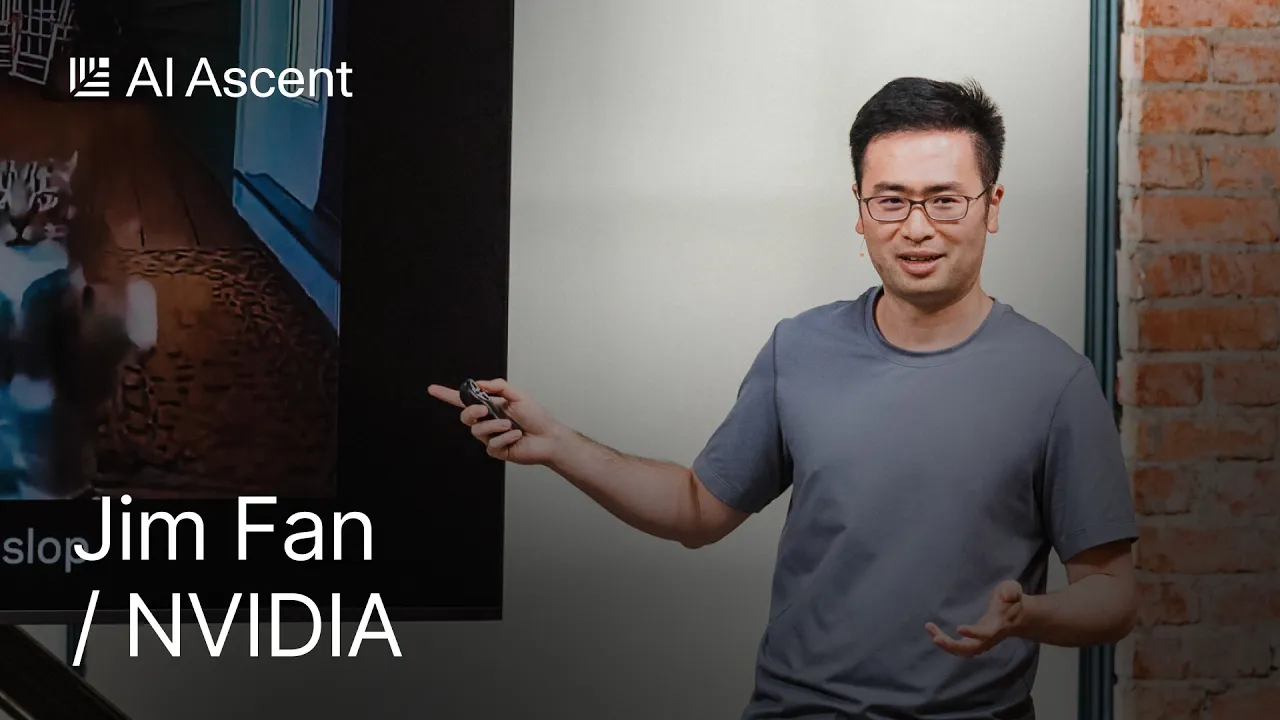
At Sequoia Capital's AI Ascent in April 2026, Jim Fan, who leads NVIDIA's embodied AI research group, presented what he called "the Great Parallel."
His thesis: robotics is following the same trajectory that language models took, but with different inputs at each stage. Language models learned the structure of text by predicting the next word across trillions of words written and indexed on the internet. They were fine-tuned to follow instructions. They used reinforcement learning to push past imitation into reasoning. Eventually, they began improving themselves. Fan argued that robotics is on the same arc except that video replaces text as the pretraining corpus. Action fine-tuning replaces instruction tuning. Reinforcement learning closes the last mile to reliable execution. And eventually, robots design and build their own next iteration.

The current model landscape breaks into three approaches, each handling the pre-training stage differently. The split mirrors the stages of language model development, but the input at each stage is physical experience rather than text:
Vision-language-action (VLA) models take what a camera sees and turn it directly into motion. Give it an image of a cluttered counter and the instruction "put the plate in the sink," and it outputs the joint commands to do it. Google's RT-2 established the form in 2023, and the following year OpenVLA showed that an open 7-billion-parameter model could outscore Google's 55-billion RT-2-X by 16.5 points across 29 tasks. Physical Intelligence has released successive versions of its generalist policy, from π0 in October 2024 to π0.7 in April 2026.
World models learn to predict what happens next, then turn that prediction into action. Pretrained on ordinary video, which is abundant, they develop an internal model of physics that can then be grounded onto a specific body with a smaller quantity of robot data. NVIDIA sells Cosmos, DeepMind runs Genie 3, and 1X is building its whole approach around this.
Simulation with reinforcement learning is the approach that looks most like the alignment and reinforcement stages of LLM development, where the model learns by trying and failing rather than by watching. Spin up ten thousand parallel environments in a simulator and a robot can practice a task millions of times in weeks of compute. NVIDIA's Isaac stack is the industry default.
The field is stacking these approaches rather than choosing one. Physical Intelligence's latest VLA already integrates a world model for visual subgoals. NVIDIA ships GR00T as a VLA while building its own world model. DeepMind runs both tracks in parallel.
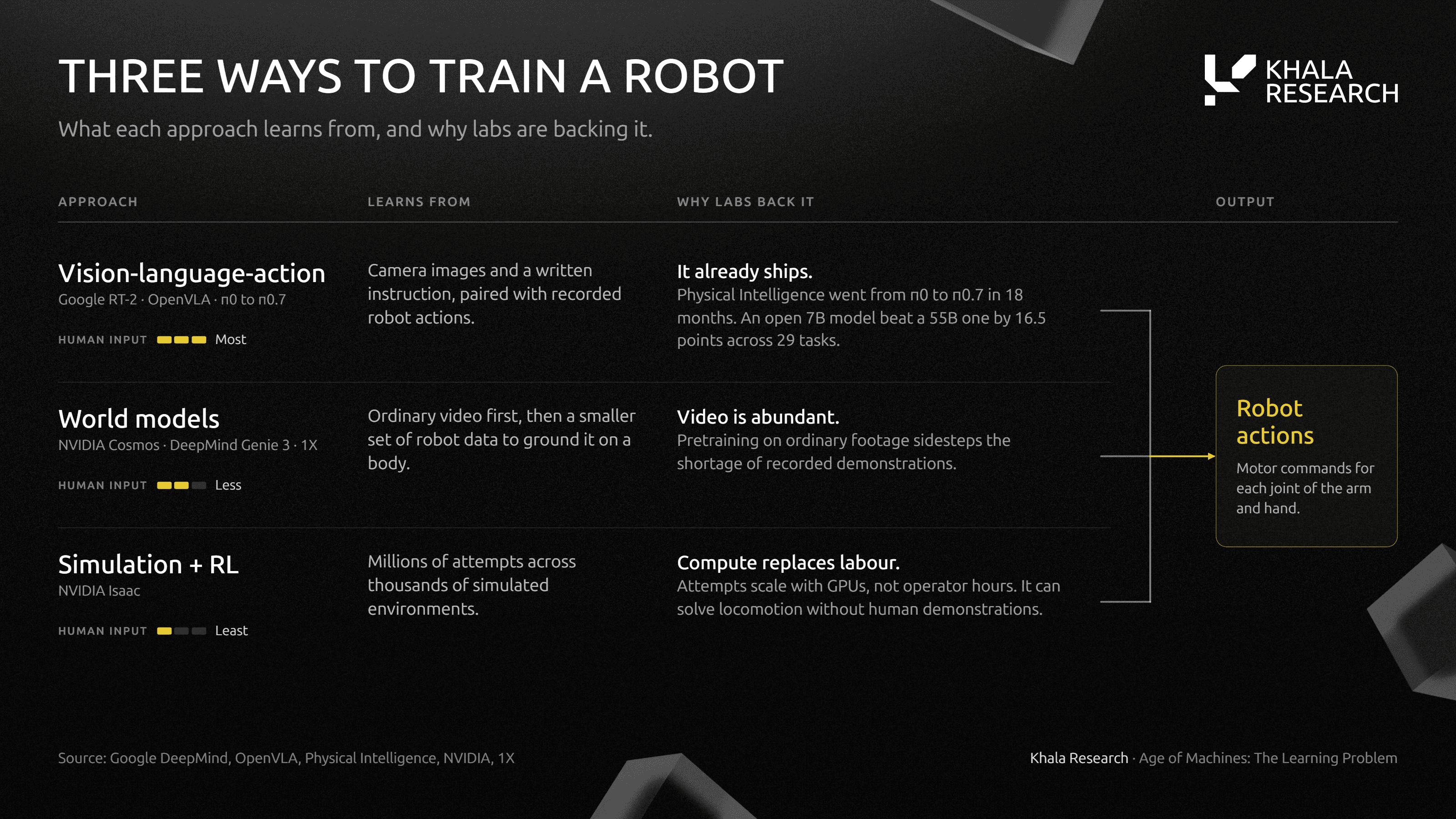
But all three share one resource. Each requires human-collected demonstration data, and each requires a different amount. VLAs need the most: paired recordings, one attempt at a time, captured while a person performs or steers the robot through a task. World models need less, because video is abundant, but still need demonstrations to ground predictions onto a real body. Reinforcement learning in parallel environments can solve locomotion without human demonstrations, but contact-rich manipulation, where the commercial value sits, requires calibration against real trajectories before a policy transfers. Simulation needs the least recorded action, and it still needs some. Whichever method wins, they all need high quality, clean data for training.
The data these approaches consume is not one thing but a spectrum, from full robot instrumentation down to a single camera on a head. Six types are in active use, each trading precision for scale at a different point, and each missing something the others have:
Teleoperated robot recordings: a person drives the target machine, and camera views, joint angles, gripper state and force are logged in synchrony with the body that will later reproduce the motion. Each stream consumes one robot and one trained operator.
Missing: nothing but volume.Operational fleet recordings: produced by machines already running a task in production, such as Figure's units at BMW Spartanburg. Recorded on exactly the deployed body.
Missing: coverage, since a fleet only ever records its own job.Instrumented human capture: gloves, wrist trackers and headsets record hand and wrist motion precisely from a human body, which then has to be translated onto a robot hand of different geometry.
Missing: force, and a matching body.Handheld gripper recordings: a person carries a gripper fitted with a wrist camera through the task, logging where the gripper went and whether it was open or closed, with no robot present.
Missing: force, and any reading of a robot's own joint positions.Passive egocentric video: a head-mounted camera and nothing else, with action labels estimated after recording by software that infers hand position from the pixels. Scene and task diversity is the highest of any type.
Missing: force, a matching body, and precise action labels.Simulated rollouts: generated in a physics engine at negligible cost and effectively unlimited volume, where contact is calculated rather than measured.
Missing: measured contact, which is the gap that opens when a policy meets a real object.

No single type is sufficient on its own. Teleoperated recordings capture everything a robot needs, but one operator with one robot produces several hours a day at best, and fewer productive hours at that. Fleet recordings inherit the same ceiling and add a worse one: a robot welding car frames at BMW records welding car frames at BMW, and nothing else. Passive video is abundant but lacks the action labels and force readings a policy needs to learn from. Simulation can generate enormous volumes of data, bound only by compute, but when a robot hand touches an object, the engine calculates what should happen rather than measuring what actually does. Getting contact right is the hard part, and that’s the actual goal. Every type hits a wall that the next type does not share, which is why the field does not pick one. Instead, it stacks them.
EgoMimic, from Georgia Tech and Stanford, tested this directly. Its model, trained on two hours of robot teleoperation plus one hour of human hand video recorded on smart glasses, scored 128 points on a task, against 74 for a standard imitation-learning model (ACT) trained on three hours of robot data. An hour of human recording yielded about 1,400 demonstrations, against 135 from an hour of robot teleoperation. Across a range of manipulation tasks, the method beat the standard baseline by 34%-228%. The cheaper data was worth more per hour.

But volume alone does not solve the problem. Robotics data is tied to the machine and setup that produced it. A head-mounted camera captures different information from a wrist-mounted camera. A dual-arm robot moves differently from a single arm. Two datasets may show the same task and still be incompatible with the same policy. Task definitions add another layer: an instruction like "organise the desk" leaves basic questions unanswered. Where should each object go? What counts as organised? Does partial completion pass or fail? As collection scales, unclear instructions create inconsistent demonstrations and make the data harder to train on.
This means buyers need more than a number of recorded hours. They need to know the camera configuration, robot design, available actions, task definition, success criteria and recorded failure modes. Without that information, two datasets with the same task label cannot be compared, priced, or evaluated until after an expensive training run. Annotation and verification provide the missing structure: annotation breaks a demonstration into labelled actions, and verification checks whether the recording is complete and compatible. These steps determine whether raw footage becomes training data or remains an unusable video file.
Three datasets show what that landscape looks like in practice:
NVIDIA's EgoScale, posted to arXiv in February 2026, is 20,854 hours of egocentric human video, more than twenty times larger than any prior dataset used for human-to-robot transfer. Most of it is in-the-wild footage from head-mounted cameras. Hand positions are recovered afterwards by software that infers where fingers and palms are from the video pixels. The authors describe these estimates as noisy. 829 hours come from EgoDex, recorded on Apple Vision Pro, which tracks wrist and hand position through the headset's own sensors rather than guessing from video. A smaller, separate set used in a later training stage comes from Vive trackers and Manus gloves that record 25 joint transforms per hand. That hardware is what an operator wears to drive a robot arm in teleoperation. In EgoScale, a human wears the same gloves and performs the task with their own hands. No robot is involved, but the data format is identical to teleoperation. So within a project filed under "egocentric human video," the most precise data comes from teleoperation hardware with the robot left out.
Figure's Project Go-Big, announced in September 2025, is also filed as egocentric human video. Brookfield, an asset manager with over 100,000 residential units, opened its properties to Figure for data collection. The footage was collected passively as people went about their day in Brookfield homes. That footage trained Helix to navigate cluttered houses from spoken instructions like "walk to the kitchen table," without a single robot recording of the navigation task. EgoScale's highest-fidelity tier produces 25 joint transforms per hand. Go-Big produces pixels and a route through a building. Both are egocentric human video.
Xiaomi-Robotics-1, posted to arXiv in July 2026, ran the full stack in one training run. The model was pretrained on 100,000 hours of handheld gripper video collected with UMI devices, a handheld rig that logs gripper position and camera view without a robot present. It was then aligned on 7,200 hours of real-robot data. Each new task took under ten hours of robot data to adapt. The pretraining teaches the model what hands do with objects. The alignment maps that onto a robot arm. The final hours are a rounding error in the total, and they are what determines whether the robot can do the task.
2. DIVERSE DATA
DATA COMPANIES ARE CROWDING INTO THE ROBOTICS DATA MARKET
Bessemer estimates the global stock of robot manipulation data at roughly 300,000 hours, about 34 years of footage. Berkeley roboticist Ken Goldberg calls this the 100,000-year data gap: that is how long a person would need to read the text behind today's language models. Companies are already building to supply more, and the ones moving fastest are the vendors that sold labelled text to AI labs through the language boom. Meta paid $14.3B for a 49% stake in Scale AI in June 2025, valuing it at $29B.
Google, Scale's largest customer at roughly $150M in 2024, planned to cut ties within days. Microsoft was also pulling back and xAI looked to exit, while OpenAI had already scaled back months earlier. Rivals worried that working with Scale could expose their research priorities and roadmaps to a competitor. What Meta bought was the management layer: recruiting, training, supervising, and quality-checking thousands of contractors to a written standard is the same operating problem whether the task is ranking model outputs or steering a robot arm through a task.
Mercor raised at $10B in October 2025 and was in talks at $20B within a year. Surge AI sought $1B above a $15B valuation, with Bloomberg later reporting talks at $25B. Scale expanded its Data Engine into physical AI in September 2025 and reports more than 100,000 production hours completed at its San Francisco lab, for customers including Physical Intelligence, Generalist AI, and Cobot. Labelbox, Encord, Mercor and Appen have each moved into teleoperation or egocentric capture. Bessemer estimated in April 2026 that industry spending on robot data will exceed $3B over the next two years. Figure committed to spending over $1B on data and compute in the twelve months following August 2026. The supply side is forming around a scarcity, and the capital flowing into it assumes that scarcity persists.
Vendors price by the hour or by the head. The buyer funds each attempt and inherits every reject. In language data, a rejected label costs cents; in robotics, a rejected trajectory costs a robot-hour. Label Studio says hourly billing "shifts all quality risk to the buyer," and the cost compounds at the acceptance rate. A buyer paying $100 an hour at 55% acceptance gets 55 usable hours per hundred. A buyer paying $150 an hour at 90% acceptance gets 90. The cheaper rate costs more per usable hour, and the rejected hours still consumed a robot, an operator, and facility overhead. Academic work on crowdsourced labour, from Wang, Ipeirotis and Provost, covers worker pay but not vendor contracts.
Buyers are already paying. Mecka raised $60M across two rounds on human-motion data and projects $100M in annual run rate on signed contracts. Four open networks covered in this report, Axis, BitRobot, Eastworlds, and THOR, have collectively raised under $25M in disclosed funding. One vendor's projected revenue exceeds the total capital of every open network combined. The open networks' proposition is a different incentive: contributors earn a stake in the corpus they are building rather than a wage for the hours they spend building it.
3. ROLE OF CRYPTO
OPEN SOURCE WILL ACCELERATE DATA TO POWER GENERALISATION
A robot trained on American kitchens handles a German one well enough, until it doesn't. A different layout, an unfamiliar appliance, a door handle at an unexpected height. Each is a gap in the training data, and gaps are where generalisation breaks. The unsolved problem is getting data from enough places to fill them.
Setting up robot data collection in a new country means legal entities, contracts, and payroll before a single trajectory is recorded. That overhead is only worth absorbing where the expected volume justifies it, so coverage concentrates where vendors already operate. People who want to contribute in countries with no vendor presence can't, because there's no contract and no payment rail to join. The environments that break generalisation are the ones no one is collecting from, and some of those gaps are ones nobody knows about. A single lab only sees its own environments. A network spread across countries runs into failure modes that would never surface in one location.
Figure's Index app shows what spreading across the globe costs the traditional way. In the four months before its public launch in August 2026, the app passed 264,000 downloads across more than 100 countries, and creators have uploaded over 16 million videos of tasks in their homes. Figure has paid $15M to creators and committed over $1B to data and compute for the following twelve months. The demand is there. Getting to it required a dedicated product team, payment infrastructure in every country, and a marketing budget to match.
An open network using crypto removes those barriers. Payments flow through the token, so anyone with a phone or a browser can earn for demonstrating a task, regardless of whether a vendor has set up in their country. Some won't care about earning a few dollars but a token that might appreciate is a different incentive. Some designs can even give contributors a stake in the dataset or governance rights as well. The token also funds collection before any buyer has commissioned the data, because the corpus has to be built before it can be sold. Where networks open-source their tools and models, every contributor who joins benefits from what previous ones built, fixes one person makes become improvements everyone reuses, and a larger corpus makes the token more valuable. Without a vendor filtering the output, the network has to police itself: scoring contributions, routing validation to trusted participants, filtering bad data before it enters the corpus. The validation layer is critical to crowdsourced data. This matters most for smaller robotics teams. Building an internal collection operation requires hardware, operators, local infrastructure and ongoing management; building a separate annotation and quality-control team adds another layer of fixed cost. Most startups and research teams cannot fund both. An open network turns those fixed costs into an on-demand service.
Four projects are building on this thesis and we are excited about each for different reasons:
Axis has a large contributor base teleoperating simulated robots through a browser, with every trajectory scored for quality before it enters the dataset. Published results, co-authored with researchers from Georgia Tech, NTU and six other universities, showed crowdsourced simulation data outperforming a competing academic dataset by 37%.
BitRobot is a coordination layer for embodied AI that pulls together robots, teleoperators, researchers, and compute across a network of subnets. Each subnet generates a different type of training data, and the network runs competitive benchmarks with external validation to test model performance.
Eastworlds operates a fleet of 50+ robots, including Unitree G1 humanoids and YAM robot arms, offering teleoperation and deployment support to robotics teams. Human supervision during deployment catches failures in real-time, and each intervention becomes training data for the next model iteration.
THOR is a marketplace for verified robotics training data built on Bittensor. Customers post a specification with an acceptance rubric, miners produce annotations, and validators test each submission against the rubric before it is accepted into the dataset. The model assumes that the bottleneck in robotics data is not collection but verification: raw footage is abundant, but footage a lab can train on requires action labels, temporal segmentation, and a shared definition of what counts as complete.
4. AXIS ROBOTICS
A distributed data engine collecting robot training trajectories through browser-based simulation, with contribution records signed onchain.
AT A GLANCE
Category: Simulation and egocentric robotics training data
Platform Scale: 7M+ trajectories, 220K+ contributors (Oct 2026)
Research Dataset: 1.53M trajectories, 1,800+ tasks (Franka subset of Axis's multi-embodiment data pool)
Funding: $12M seed (Jul 2026)
Products: task generation, simulation collection, egocentric capture, data processing, model training
Risk: Scale and performance metrics are from Axis's own dashboard and preprint; the dataset is publicly available for verification
Watch For: $AXIS TGE; first independent benchmark of AXIS-V1 results
Strategic Positioning
Axis Robotics is building a distributed training-data factory for robots. People around the world teleoperate simulated robots through everyday tasks in a browser, the platform scores each attempt, and the trajectories that pass go into the dataset. Most robot data pipelines run in one direction. Collect data, train a model, ship it, start over. Axis runs a loop. When the trained policy fails on a task, the platform opens more collection for that task. Model weaknesses become the next data request. The team calls this a compounding data engine, and it runs across both pre-training, where contributors teach tasks from scratch, and post-training, where they correct a trained policy's mistakes.
Robot training data is usually expensive to acquire. A teleoperation station costs hardware, a trained operator, and facility overhead, and it produces a few productive hours per day. Vendors like Scale AI and Mecka are building businesses on that cost structure, pricing by the hour and passing quality risk to the buyer. Axis's core bet is that diverse training data, more than compute or model architecture, is the bottleneck in robotics, and that the cheapest way to produce it at scale is browser-based simulation. At matched data volume, the crowdsourced output outperformed RoboCasa365, an established academic simulation dataset.
No robot hardware, no lab space, no country-specific payroll. A contributor needs a laptop and an internet connection. The simulation runs locally in the browser, not on servers. MuJoCo, compiled to WebAssembly, handles physics, collision, and control on the contributor's own machine. No GPU requirement, no download, no install. A contributor opens a webpage, picks a task, and starts driving a robot through a kitchen or office scene with a keyboard and mouse. The platform spans 13 robot embodiments, from single-arm to humanoid, across kitchen, home, office, workshop scenarios and more.
Crypto provides the two things a global contributor network needs: a payment rail that works without a vendor contract in the contributor's country, and a provenance layer that records who contributed what to which task. Every accepted trajectory is signed onchain, meaning everything in the dataset is traceable to the person who produced it, and the record is permanent.

Context
Axis was founded in 2025 to build the training data that robotics lacks. Algorithms and compute are ready; the field's bottleneck is everyday physical data, recorded at scale across enough environments to train a general-purpose robot. No dataset exists at the scale and variety robotics needs for everyday physical tasks like picking up a mug, folding a shirt, or pouring coffee across the range of settings a robot would encounter outside a lab. Co-founder and CEO Chris Feng estimates that GPT-3 trained on the equivalent of roughly 15 million hours of human internet data, and puts what physical AI needs at around 100 million hours of human interaction data.
The platform launched on Base in March 2026 and has grown to over 220,000 contributors and over 7 million trajectories. The core idea, according to Feng, is a growable data engine, not a single data product. Model requirements shift as the field evolves, and he does not want to lock Axis into one modality. Today the priority is simulation data and egocentric video. Correction data is already in progress, with a first dataset targeted before year-end. A distributed contributor network can support multiple data pipelines, from simulation to egocentric capture to human-guided correction data.

Four products make up the pipeline:
Task Generation Engine. A natural-language instruction enters the system and the engine generates tasks across four dimensions: scenarios, atomic capabilities, intra-task layouts, and asset randomisation. A single prompt such as "Pick up the mug from the counter and place it in the cabinet" expands into many scene instances. In Axis's own example, 40 layouts with 4 asset variants each give 160.
Sim Data Collection Platform. The core channel and the one that produced every published result. Each trajectory is replayed to verify physical consistency, scored for task success and motion quality, and signed onchain. Invalid submissions never reach training. Axis V2, released 10 July 2026, closed the loop: a trained policy rolls out autonomously, and when it fails, the contributor intervenes with corrections and hands control back. Less intervention earns a higher score. In research published on its blog, Axis filtered 660 correction candidates down to 161 snippets of roughly 0.8 seconds each. Those snippets worked where imitating full human trajectories did not.
Data-Processing Pipeline. The pipeline handles replay verification, cleaning, domain randomisation, and photorealistic augmentation. The simulation frontend runs in the browser. The realism backend runs on GPU Linux servers.
Mobile Egocentric App. Still in development, though Axis is already collecting egocentric data at scale. Capture runs on Axis's own devices, operated by more than 1,000 trained, quality-scored collectors filming in real homes and businesses. Axis says it holds 200,000+ hours and adds about 5,000 hours a day across 14 industries. The pipeline converts the footage into 4D hand-pose data with language annotation. This is the human-video tier of the data stack.

In July 2026, Axis published a paper to arXiv, since accepted at the IROS 2026 Workshop on Physical World Models, co-authored across nine institutions: Axis Robotics, UC Berkeley, Georgia Tech, NTU, Texas A&M, Johns Hopkins, Penn, Michigan, and NUS. The paper asks whether data collected by contributors in browser simulations makes robot models better. The team took π0.5, an open-source model that controls how a robot arm moves, and continued training it on Axis data before fine-tuning it on the standard LIBERO tasks. Then they tested it on LIBERO-Plus, which re-runs those tasks under perturbations the model never saw in training, and measured how often the robot completed the task.
They ran a second comparison holding data volume constant: same model, same amount of training data, same tasks, but one trained on Axis data and the other on RoboCasa365, a competing academic dataset. Axis data gave the model a modest gain on its own and beat RoboCasa365 by a wide margin, with the gap widest when conditions shifted from the training setup.
Key results from the paper:
Continual pretraining on Axis data improved π0.5's success rate by 5.8% (83.9% to 88.8%)
Axis-fed π0.5 outperformed RoboCasa-fed π0.5 by 37.3% at equal data volume (88.8% vs 57.5%, with the gap measured against the 83.9% baseline)
The biggest gains over the baseline came under shifted camera angles and sensor noise
Performance scaled with data volume: 84.7% on a quarter of the Axis data, 85.7% on half, and 88.8% on the full set
Axis released the AXIS-V1 dataset behind those results on Hugging Face alongside the paper: 50,000 trajectories across 207 tasks, available to researchers but licensed for non-commercial use only.

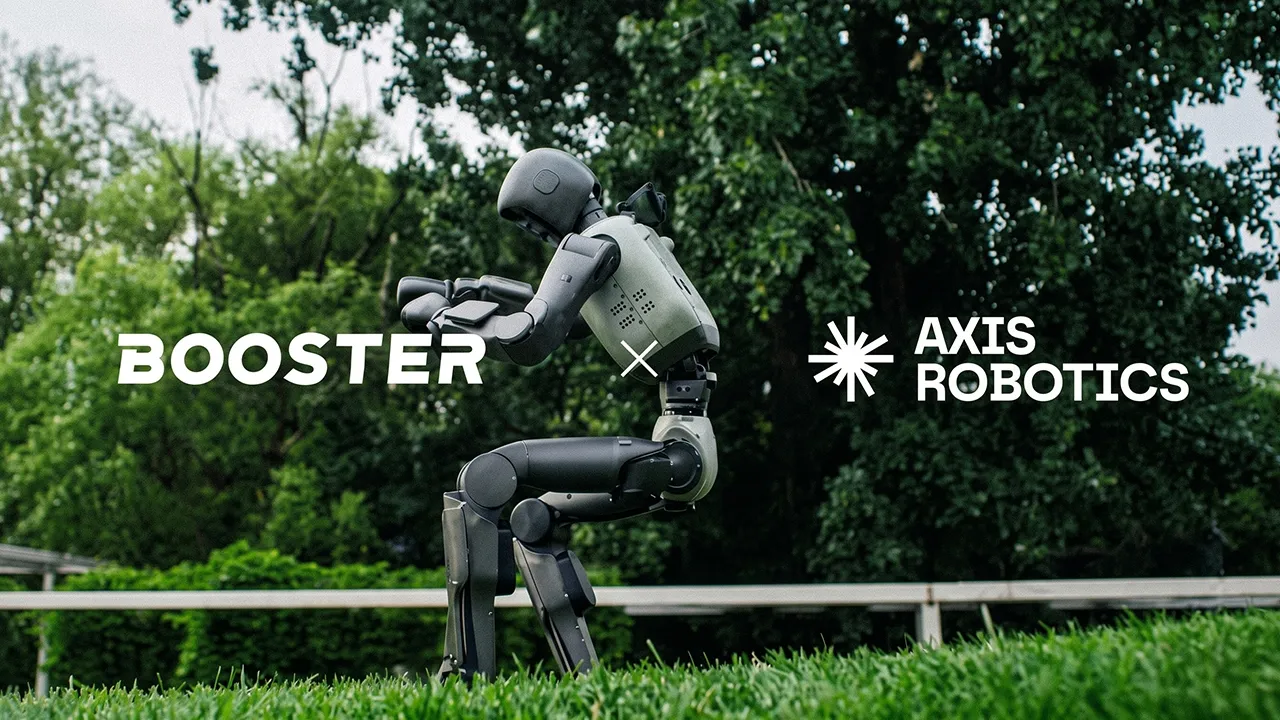
Axis's first commercial partnership is with Booster Robotics, a humanoid robotics company with ~$150M raised, two bipedal platforms sold as developer hardware, and more than 1,000 K1 units shipped to 400 clients in more than 20 countries. Axis is Booster's first simulation-data partner. Booster needed a manipulation policy for its hardware. Axis rebuilt Booster's real workspace as a digital twin, and contributors collected 42,000+ simulation episodes on it. Those episodes pre-trained a model for Booster's T1 humanoid, which was then fine-tuned with 30 real-robot demonstrations. In Axis's simulated evaluation, that model succeeded 87.5% of the time, against 37.5% for an out-of-the-box π0.5. In physical trials on the robot, adding Axis simulation data to Booster's real demonstrations raised lift success by 5 to 10 percentage points.
It is the first commercial use of Axis data on a partner's hardware. Axis designs tasks for Booster's hardware, collects data through its contributor network, trains a policy, and packages it into repeatable products that Booster resells to its own customers under a co-branded package, in task sets of 5 to 20.

Axis has also announced partnerships with Feagine Robotics for flexible manipulator data pipelines, and with Dexmal, an embodied intelligence company, as a core data infrastructure partner. For Manycore Tech, a spatial intelligence company that went public on HKEX in April 2026, Axis Suite supplied physics-ready simulation assets to train its 3D generative model. Lotus and Geely are working with Axis on automated production-line component sorting covering 500 to 800 SKUs.
Axis sells through three channels:
Embodiment integration for robot hardware companies.
Robotics data for model teams.
Industrial sim-to-real for enterprise deployment.
Axis has since moved from collecting more tasks to building what it calls a composable library of robot skills. Starting from a small amount of contributor data, it trains an expert policy for each task that can recover from knocks and shifted starting positions. That lets experts be chained, with one expert's finishing position becoming the next one's start. Axis groups them into skill families such as packing, sorting and tool grasping, and plans to distil them into general models. Each expert takes three to six hours on a single A100 GPU, about $5 to $10 of compute, and reaches close to 100% success in simulation. In one demo, an expert reached 97% in about 20 minutes on a single consumer graphics card. Axis has also started testing on real hardware. A policy trained only in simulation succeeded 22% of the time on a real robot, and retraining it with its own successful real-world attempts alongside the simulation data lifted that to 52%, and keeping only the best half of those trajectories took it to 76%.
Axis was founded by Chris Feng and Christine Cao. Feng came from data infrastructure, where he was COO of Chainbase, a blockchain data network. He has said he models Axis on Surge AI, a data-labelling company that bootstrapped to $1B in revenue on text data, and sees the same opportunity in physical AI. Cao is CMO, with prior operations roles at Uber, Walmart eCommerce, and Nestlé. Professor Jiachen Li of Georgia Tech, director of the Trustworthy Autonomous Systems Laboratory, advises the research and co-authored the AXIS-V1 paper. Axis has grown to approximately 30 team members and raised a $12M seed round in July 2026, led by Hack VC, with Nomad Capital, Pi Network Ventures, 10K Ventures, and angels. Feng has said in an interview that Axis has secured paid orders and set a six-month ARR target of $500,000 - $1,000,000, and the whitepaper now targets $1M+ by the end of 2026. Axis has since told us at Khala Research that the framework agreements it is currently fulfilling exceed $1M in total, though that figure has not been independently verified.
The company is pre-token. Axis has published tokenomics for $AXIS, planned for Base: the token rewards contributors for accepted data, paying for collection before a buyer commissions it, and funds partnerships, research and community programmes, with staking for access to higher-value tasks proposed but not yet defined. Contributing to the platform does not require holding it. Axis also operates SN/04, a subnet on the BitRobot Network, where contributors complete the same simulation tasks and earn rewards from both Axis and BitRobot. The tasks and data are the same either way; only the verification chain and reward program differ. Axis plans to expand first-person video collection and release its first large-scale correction dataset before the end of 2026.
The dashboard, the research dataset, and the paper each measure a different layer of the platform. The paper evaluates a snapshot of 50,000-plus curated trajectories across 207 tasks from 70,000-plus community members. That Franka dataset has since grown to 1.53 million trajectories across 1,800+ tasks, a subset of the 7 million-plus on the dashboard. The comparisons were run by the paper's authors, Axis among them, and no independent replication has been published so far. An outside team including researchers from Westlake University and the University of Chinese Academy of Sciences has since listed π0.5 + AXIS as a LIBERO-Plus baseline in its own paper, citing the AXIS results.
Eighteen months in, Axis has a contributor network in the hundreds of thousands, a workshop-accepted paper, and a first commercial partner in Booster. The ambition is to be the data layer that robotics companies build on. Model failures become the next data requests, the data requests become trajectories, trajectories become better models. That loop is what the company is betting on.
Catalysts:
First independent benchmark of AXIS-V1. A third party running the AXIS-V1 dataset against π0.5 and confirming or refuting the 37.3% gap against RoboCasa365 is the single most important external signal for the data quality thesis.
Sim Dataset V2 paper. V2 scales the dataset to 1.2M trajectories across 1,200 tasks, and Axis has submitted a paper built on a subset of it to a leading robotics conference. Publication would show whether the AXIS-V1 gains hold on a much larger dataset.
First DAgger dataset (EOY 2026). Axis plans to release the first large-scale human-gated correction dataset. The V2 blog post identifies this as a gap across both academia and industry. First-mover position in correction data would open a product category that isn’t currently served.
$1M+ ARR target (EOY 2026). Axis informed us that the framework agreements it is currently fulfilling already exceed $1M. Converting those into recurring revenue that customers can confirm is the first hard commercial signal, and the first figure that can be independently verified.
$AXIS TGE. First live market pricing of $AXIS establishes whether the token trades at a premium to the community sale price and sets the baseline for assessing value accrual.
Risk Factors:
Sim-to-real evidence is self-reported. The AXIS-V1 benchmark results are measured in simulation. The Booster result, 87.5% against 37.5%, comes from a simulated evaluation, and trials on the physical robot showed gains of 5 to 10 percentage points. The 22% to 76% real-robot results come from Axis's blog without a published method. No independent group has yet shown Axis data improving a real robot, and the thesis depends on it.
Single-embodiment evidence base. All of the paper's results cover the Franka FR3 arm. The platform spans 13 embodiments and the Booster result runs on a humanoid, but the 37.3% gap against RoboCasa365 and the scaling behaviour are demonstrated on one arm.
Pre-token, with value accrual undefined. Axis has published how $AXIS is allocated and released, but staking is still proposed and nothing yet ties platform revenue to the token. Contributors are rewarded in $AXIS, so the incentive that draws them depends on the token’s market price rather than on what buyers pay for the data. Team and investor tokens also begin unlocking a year after launch.
Outlook
Axis has built a data engine producing millions of trajectories from contributors in a browser. The published result is a 37.3% quality gap over RoboCasa365, an established academic simulation dataset, at matched volume, and no vendor in the category has a comparable rerunnable benchmark. The simulation pipeline runs without robot hardware, operator payroll, or facility overhead, and onchain provenance gives every trajectory a signed record a buyer can audit.
Sim Dataset V2 scales to 1.2M trajectories across 1,200 tasks, and a paper built on it is under review. A human-gated correction dataset planned before year-end would be the first large-scale entry in a category that neither vendors nor academia currently serve. If the gains hold beyond the Franka arm, a single result becomes a method.
The paper covers one arm in simulation, the real-robot results so far are Axis’s own, and the token’s link to platform revenue is not yet defined. If the $1M+ in framework agreements converts into recurring revenue and an independent group confirms the quality gap, vendors charging by the hour for teleoperation data are selling a more expensive version of something that works less well.
5. NOTABLE MENTIONS
5.1 BITROBOT

BitRobot is a network for crowdsourcing robotics data collection and evaluation. Robotics breakthroughs will not come from a single lab but from coordinated contribution at scale, and data from any use case improves models for all use cases. That is the project's thesis, and the subnet architecture is how it executes on it. The network organises researchers, hardware operators, and contributors into subnets, each focused on a different type of robot data. Juan Benet co-developed the network with FrodoBots Lab and has credited Bittensor with the framework it builds on, saying Bittensor contributed "a much more general framework for assessing valuable contributions to a network through the use of these different subnet structures." BitRobot runs on Solana with its own governance and reward mechanisms, and has no presence on the Bittensor chain. Public subnet outputs default to open source for non-commercial use, with commercial licensing through the Foundation. Contributors earn Bolts, a capped, non-inflationary offchain points system for BitRobot’s pre-mainnet phase, with 30-day epochs and dynamic multipliers that shift rewards toward the subnets generating the most commercial value. Bolts are non-transferable and carry no promise of a future token allocation.
The subnets span outdoor navigation, indoor manipulation, humanoid deployment, and first-person video. The newest, RoboCap (SN/06), launched in August 2026 and is a major push into egocentric data. Contributors wear a headset with four cameras facing outwards and two pointed down at their hands, and every recording is encrypted on the device, so the footage can only be used on the BitRobot network. ET Fugi is the oldest, turning outdoor sidewalk rovers into a gamified scavenger hunt where players remotely drive real robots to complete missions on real city streets. TeleArms operates simulated robotic arms in a browser-based playground, lowering the hardware barrier to zero for contributors generating manipulation trajectories without physical access to a robot. Axis runs SN/04 for browser-based teleoperation of simulated Franka FR3 arms and is the primary subject of this report. Each subnet defines its own missions and validation criteria, contributors execute the work, and validators score the output before it enters the dataset. The design assumes that cross-domain exposure across these different data types is what makes models generalise.
The clearest evidence that the network produces real research output is that researchers are using it: papers from groups including UC Berkeley, MIT CSAIL, UCLA, Peking University and Unitree Robotics cite its datasets. Its Grand Challenges program adds a public benchmark. The Foundation runs a $5M prize fund where AI models compete against human reference runs on standardised tasks. Three challenges ran at IROS 2026 in Pittsburgh: Earth Rover for outdoor navigation, Robotic Origami for paper folding, and IKEA Assembly for humanoid assembly, where a Unitree G1 builds an IKEA table against a human time benchmark. Results from Pittsburgh have not yet been published. Earth Rover has run before, and its results show AI closing on humans: the top AI team reached 37% of the human ceiling at IROS 2024 and 57% at ICRA 2025. Co-organisers include Unitree, Sharpa, Lightwheel and Toyota Central R&D Labs, alongside researchers from Google DeepMind, NUS, NYU, Stanford and Tsinghua.
The project began as FrodoBots Lab, founded by brothers Michael Cho and Sam Cho, who started in 2022 with outdoor teleoperation rovers and open datasets. Juan Benet co-developed the network as whitepaper co-author, with Jonathan Victor as Foundation president. The team raised a $6M seed round led by Protocol VC in February 2025, bringing total funding to $8M, with Solana co-founders Anatoly Yakovenko and Raj Gokal as angels.
5.2 EASTWORLDS

Eastworlds claims to operate a fleet of 50+ robots, including Unitree G1 humanoids and YAM robot arms, from a facility in Kuala Lumpur, providing teleoperation data and deployment services to robotics teams. It was launched by Virtuals Protocol, which positions robotics as the physical labour layer of its agent economy. Eastworlds owns its hardware and runs the teleop itself, selling the output as a service rather than coordinating a contributor network. Operators use VR headsets to control the G1s, and the company has been testing the fleet for roughly six months, debugging hardware and building operational knowledge of what the robots can and cannot do. It has also started collecting whole-body UMI data, so its supply no longer depends on teleoperation alone.
Eastworlds describes a three-part model. Teleoperation datasets feed imitation learning pipelines, with a public dataset explorer listing each dataset's episodes and frame counts. Neodeployment puts teleoperated robots to work in retail, hospitality and security as a service, so they earn before they are fully autonomous, and each deployment feeds new data back into training. An accelerator gives external robotics teams funding, hardware access, pilot introductions and software tooling in month-long residencies. Its research partners have included CMU, NTU, Oxford and Shanghai Jiao Tong, and residents have included people from BitRobot, PrismaX, FrodoBots and ETH Zurich Robotics Club, alongside researchers from CMU and NTU.
Two datasets are published on Hugging Face under Apache 2.0, including G1_pick_yellow_bottle with 2,484 rows of synchronised video and robot state data. The company claims 500,000 recorded tasks and 200 teleoperation hours per week. Both figures originate in company channels and the definition of "task" is not published. No named commercial customer has been disclosed.
Bryan Lim is co-founder and chief scientist. Lim holds a PhD in AI and robotics from Imperial College London, completed a year at MIT, and was a principal research scientist at Autodesk AI Lab before joining Eastworlds. His prior research spans reinforcement learning and quality-diversity, with publications in Nature Communications, AAAI, ICRA, and JMLR, and he created QDax, an open-source quality-diversity library. Lawrence Opferkuch leads data operations and represented the company on the Supercycle podcast in August 2026. Danial Azmi is COO. No external funding round has been disclosed. Eastworlds is funded within the Virtuals Protocol ecosystem.
5.3 THOR

THOR is an open network for robotics data, hardware, and deployment, launched by Pylon Partners on Bittensor subnet SN112 in September 2026. The labs that can afford to buy robotics training data keep it private, which is why no open supplier exists. THOR creates one: a global crowd paid through Bittensor incentives to collect, annotate, and verify data that any lab can use, with enterprise buyers funding the network and receiving time-limited exclusivity before commissioned data is released openly. Jack Ai-Leung, managing partner at Pylon Partners, frames the project as the bridge between Chinese hardware manufacturing and Western open research, a combination neither side's industrial policy produces on its own.
THOR Data is the first of six planned arms, launching as a marketplace where a buyer posts a specification for the training data they need and acceptance criteria are fixed before anyone bids. Miners produce the work through collection, annotation, or validation. Validators check every submission against the posted spec, with gold-standard control samples injected unseen into the work. Only output that passes is delivered and paid for. The model assumes that the bottleneck in robotics data is not collection but verification: raw footage is abundant, but footage a lab can train on requires action labels, temporal segmentation, quality gates, and a shared definition of what counts as complete. THOR Simulation captures a physical scene once and recreates it in software through SimArena, a browser-native platform running physics in WebAssembly, to generate training episodes without frame-by-frame labelling. THOR Hardware designs capture kits for stereo POV, camera glasses, and handheld grippers with 6DoF tracking. THOR Research partners with university labs on open benchmarks, with researcher access free. THOR China captures raw footage where operators and hardware are concentrated, and the network verifies and sells output to labs in the US and Europe. THOR Deployment runs industry pilots where the full stack is tested under operating conditions, with field results feeding the next collection cycle. The project is at launch stage, with GitHub and a public dashboard listed as coming soon.
Jack Ai-Leung previously led strategy for the Immutable Token Foundation through its token launch and is a co-founder of Khala Research. Wenji Cheng leads THOR China, with venture capital experience at Foresight Ventures and 3G Capital. No external funding round has been disclosed.
6. SCENARIO TABLE
The scenarios below look at how open robotics data networks could develop over the next two years.
Scenario | Conditions | Ecosystem Implication | Signal to Watch |
Bear | Independent attempts to replicate open-network data quality results fail or produce weaker findings than the original self-authored benchmarks. Commercial buyers stay with vendors for guaranteed output. Open networks plateau as research projects with contributor bases but no contract revenue. | Scale, Mercor and Appen retain their hold on robotics data spend. Open networks capture under 5% and remain pre-revenue or subscale. The cost structure does not change: buyers keep paying per hour and inheriting rejection risk. | arXiv for independent replication studies (positive or negative). Commercial partnership announcements from open networks. Vendor ARR disclosures. |
Base | One or two independent benchmarks confirm open-network data quality on at least one embodiment. Commercial pilots convert to paid contracts. Vendors respond by competing on price or tightening quality guarantees. | Open networks capture 10-20% of vendor spend. Scale and Mercor retain enterprise contracts but face pricing pressure. The category grows fast enough that both models coexist: vendors for guaranteed output, open networks for volume and diversity. | Independent benchmark publications on arXiv. Commercial partnership announcements. Vendor pricing changes in published rate cards or contract disclosures. |
Bull | Multiple independent benchmarks confirm quality across embodiments. Commercial buyers shift collection budgets toward open networks. Vendors consolidate, pivot to annotation-only, or exit. Open-network data becomes default citation in robotics papers. | Open networks capture 30%+ of spend and restructure vendor economics. Crowdsourced collection drops the marginal cost of a trajectory toward zero. Vendors that survive, including potentially Scale or Appen, do so by moving up the stack to annotation, verification, and managed QA. | Open-network dataset citations in published papers. Vendor M&A, down rounds, or strategy pivots. Enterprise procurement disclosures mentioning open-network data. |
7. CLOSING
Physical AI is one of the most critical changes in our lifetime, full of adventure and inconsistent training. The models can drive robots in controlled environments, but for robotics to generalise, they need diverse demonstration data that does not exist at the volume or cost the field needs. Vendors like Scale and Mercor sell that data by the hour with no published quality guarantee, and the buyer funds every attempt and inherits every reject.
Open networks are entering from a different angle. Axis has published the only rerunnable result in the category: a workshop-accepted paper showing a 37.3% quality gap over an established academic dataset at matched data volume, from 220,000 contributors producing trajectories in a browser with no robot, operator, or facility overhead.
If successful, the opportunity is smart physical tasks humans currently perform, done by intelligent machines. We believe robotics is just starting to enter its compounding phase, and the teams that integrate intelligence, hardware, and deployment into one industrial platform will define the next generation of enduring companies.
DISCLAIMER
This report was commissioned by Axis Robotics. Khala Research received compensation for its production. All analysis, conclusions, and risk assessments are independently formulated by Khala Research and have not been subject to editorial approval by the project team. This report does not constitute investment advice, a solicitation to buy or sell any asset, or a recommendation of any kind. The $AXIS token has not yet launched. Readers should conduct their own due diligence and consult legal and financial advisors before making any investment decisions.
