


Key Takeaways
General AI models have a documented, measurable failure on crypto tasks. Surf is purpose-built around that gap, and the traction it has found without a token, an airdrop, or a points program says something about the size of the problem it is solving.
- Frontier AI has a documented, measurable routing failure on crypto tasks: 67.4% accuracy ceiling against an 80% human analyst baseline. The failure is architectural: models default to web search 55.5% of the time even when a blockchain explorer would return the correct answer. Surf is purpose-built for this, combining a multi-chain indexer, real-time social monitoring, and proprietary model orchestration behind a single API. Surf reports 4x outperformance against no-tool frontier models, narrowing to ~1.2x against the best tool-augmented general model.
- 600K users, ~$3M ARR, no token: Surf built a paid subscriber base without an airdrop, token rewards, or points program. Organic growth in a sector where token incentives are the standard acquisition playbook is a signal most platforms cannot replicate.
- Surf 2.0 expands to two new customer categories: builders and agents: Surf Studio converts a natural language prompt into a deployed, live crypto application. Surf Agent Stack gives developers and agent frameworks direct access to the same underlying data via 90+ API endpoints across 12 domains with MCP server integration. Surf now serves three distinct customer types: analysts, builders, and autonomous agents.
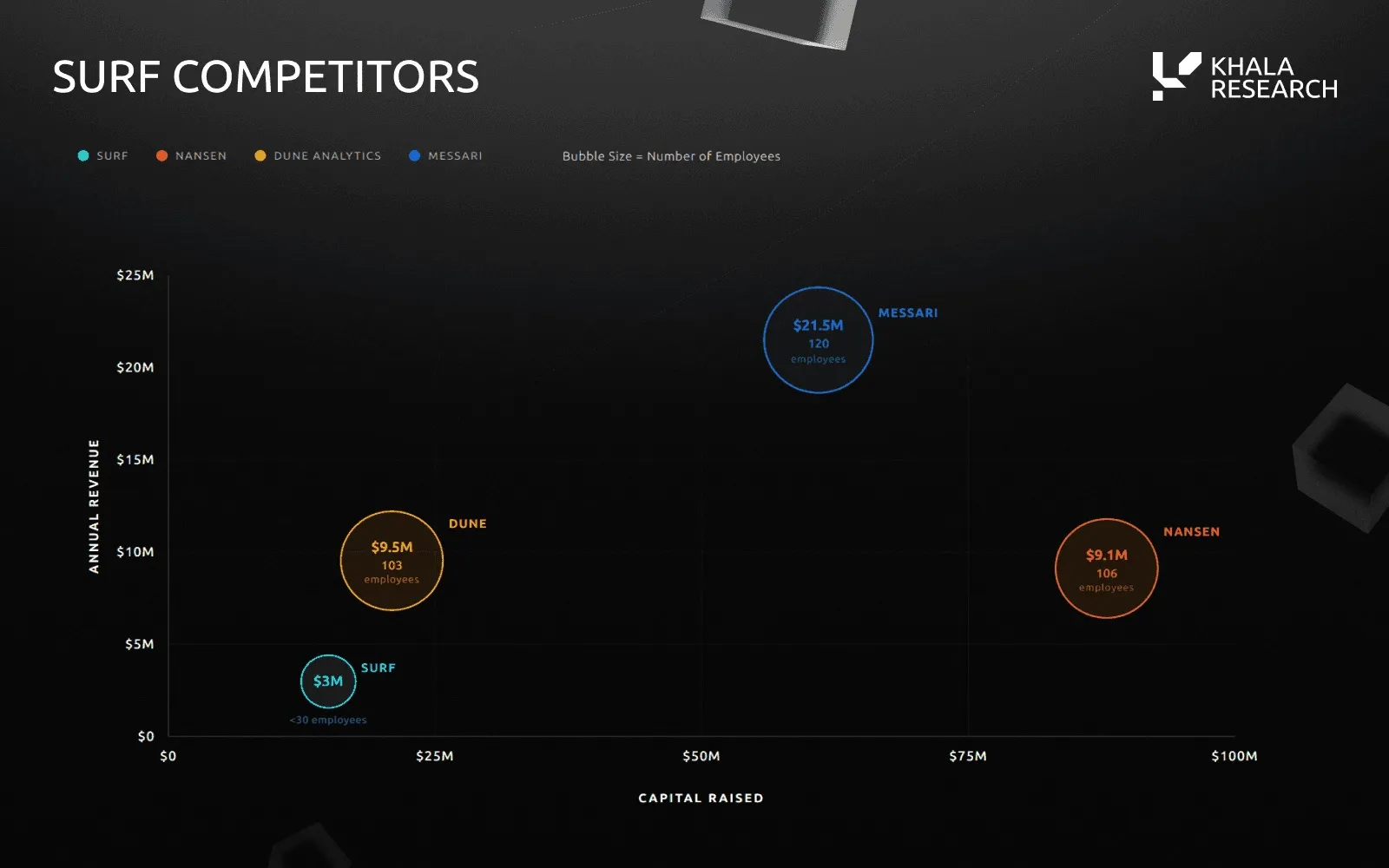
- Surf generates about a third of the revenue of Nansen or Dune with under a third of their headcount: Nansen reports $9.1M annual revenue with 106 staff and $88.2M raised. Dune reports $9.5M with 103 staff and $21M raised. Messari estimates ~$21.5M revenue with ~120 staff and $61M raised. Surf claims ~$3M ARR with fewer than 30 people and $15M raised. The capital efficiency ratio, if the claims hold, puts Surf in a different architectural category.
Executive Summary
Publicly available frontier AI models fail to route crypto questions to the right data source despite the data being available. Every transaction is onchain, every social signal is indexable, every price feed is live in real time. The CAIA benchmark makes this measurable: a 12.6 percentage point gap between the best publicly available general frontier model and the 80% human analyst baseline, driven by tool selection failures rather than reasoning quality. The routing layer is the bottleneck, not the data.
Surf is built around that gap. A multi-chain indexer, a real-time social monitoring pipeline, and a proprietary model family with adaptive routing sit behind a single API. The product found its audience without the standard acquisition playbook: 600K users and ~$3M ARR built on subscriptions, with no token, airdrop, or points program. The capital efficiency implied by that traction, against Nansen, Dune, and Messari all operating with 100+ staff and $21M-$88M raised, is the first signal that Surf's architecture is structurally different, not just earlier in its growth curve.
The Surf 2.0 launch in March 2026 shifted the addressable market from individual analysts to developers and autonomous agents. Studio converts a natural language prompt into a deployed, live-URL crypto application. The Surf Agent Stack exposes the data layer as an MCP server and Skills integration for agent frameworks. If SAS becomes the default crypto data layer in agent workflows, the same way Stripe became the default payment layer, Surf transitions from a product to infrastructure.
01The Crypto AI Accuracy Problem
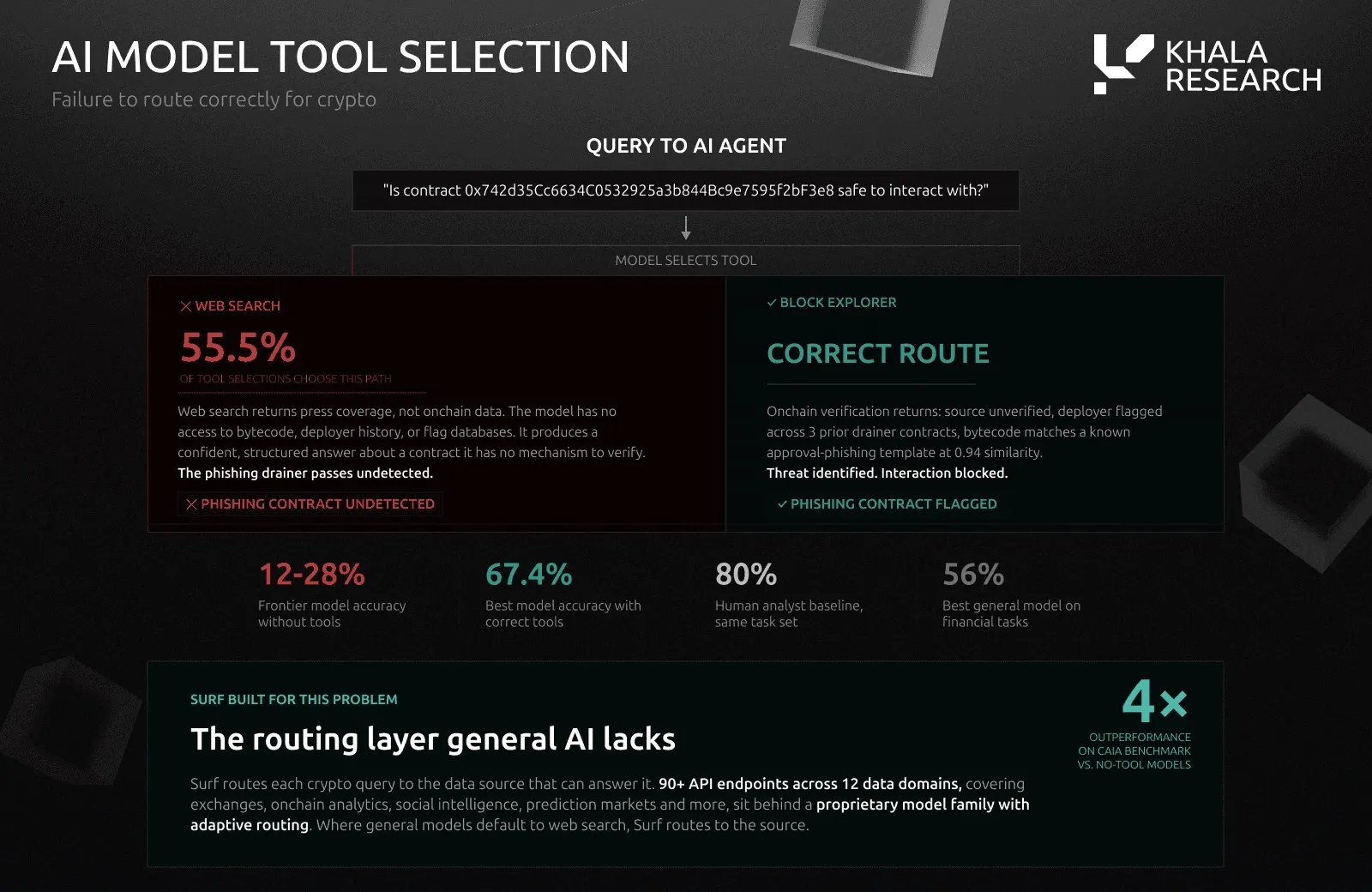
Ask a frontier AI model to check whether a smart contract address is safe. It will generate a confident, structured response. If the address is a known phishing contract, the model has no mechanism to check. It reaches for web search instead of a blockchain explorer, and returns a confident structured response. The answer looks right, but is wrong.
The CAIA benchmark provides systematic measurement of this failure. Across 17 models and 178 tasks spanning onchain analysis, market data retrieval, smart contract evaluation, and social sentiment, results fall into three tiers. Without external tools, models score between 12% and 28% accuracy. With tools, the best general model reaches 67.4%, still 12.6 percentage points below the 80% human analyst baseline. The critical finding is the tool selection failure: when specialist tools (block explorers, contract analysers, onchain data feeds) are available alongside web search, models choose web search 55.5% of the time. The routing layer, not the reasoning layer, is where general AI fails crypto tasks.
One disclosure is required before these results support product claims. Surf co-authored CAIA through Cybertino Lab, its internal research arm. The "4x outperformance" figure is measured against the no-tool frontier model baseline (12-28% accuracy on CAIA), not against tool-augmented models, where Surf's lead over the best publicly available general model is ~1.2x. Both baselines are documented in the paper; the distinction matters for sizing the moat. Princeton co-authorship (Zerui Cheng) and AAAI oral acceptance validate the methodology, not Surf's specific performance figures. The full CAIA dataset is publicly available on Hugging Face, and the team has committed to providing free API access for any academic group running a replication.
CAIA was submitted to ICML 2026 and subsequently submitted to COLM. A top-tier venue acceptance would add further independent validation, but a non-acceptance does not change the underlying research: the methodology stands on the AAAI oral acceptance and Princeton co-authorship regardless of venue outcome. Until independent teams replicate the results with Surf as a tested model, the performance claims are directionally credible, not precisely established.
Independent corroboration comes from a Vals.ai Finance Agent Benchmark (April 2025), which tested 22 leading AI models on financial analyst workflows and found the best-performing general model, OpenAI's o3, reaching 48.3% accuracy, with no general-purpose model surpassing 56%. The scope is broader (finance, not crypto-specific), but the convergence strengthens the thesis that domain-specific routing infrastructure is the architectural requirement.
The Crypto AI Benchmark Alliance (CAIBA), which Surf's parent entity joined alongside Alchemy, EigenLayer, Goldsky, Thirdweb, and eight others, frames this as a sector-wide infrastructure problem rather than a single vendor's claim.
02Surf
A crypto AI platform that built a paid subscriber base without a token, and is now expanding the same data infrastructure into the developer and autonomous agent market.
Before Surf 2.0
Surf launched as a crypto research assistant: natural language queries returning structured reports drawing on onchain data, market feeds, and social monitoring. The product found its audience. Over 600K total users and 3M+ research reports since launch demonstrate measurable adoption. CoinDesk independently reported 1M+ reports at the December 2025 raise; the April 2026 figure reflects team-reported growth since.
What the research interface produces matters concretely. A standard report covers price windows across 24-hour, 7-day, and 30-day timeframes, alongside social and news sentiment from Twitter/X, Telegram, Reddit, and media, including mention-volume trends and notable KOL commentary. Technical analysis spans spot price, volatility, funding rate, long-short ratio, and order book depth. Onchain activity covers transaction volume, active addresses, TVL, fees, whale holdings, holder concentration, and the top-10 interacting contracts. The output closes with a peer comparison table, tokenomics summary, catalyst and risk checklist, and a Bull/Neutral/Bear call with a confidence percentage. A pre-TGE variant adds exchange listing probability models for Binance, Coinbase, OKX, and Bybit. That is a full analyst workflow executed in a single prompt.
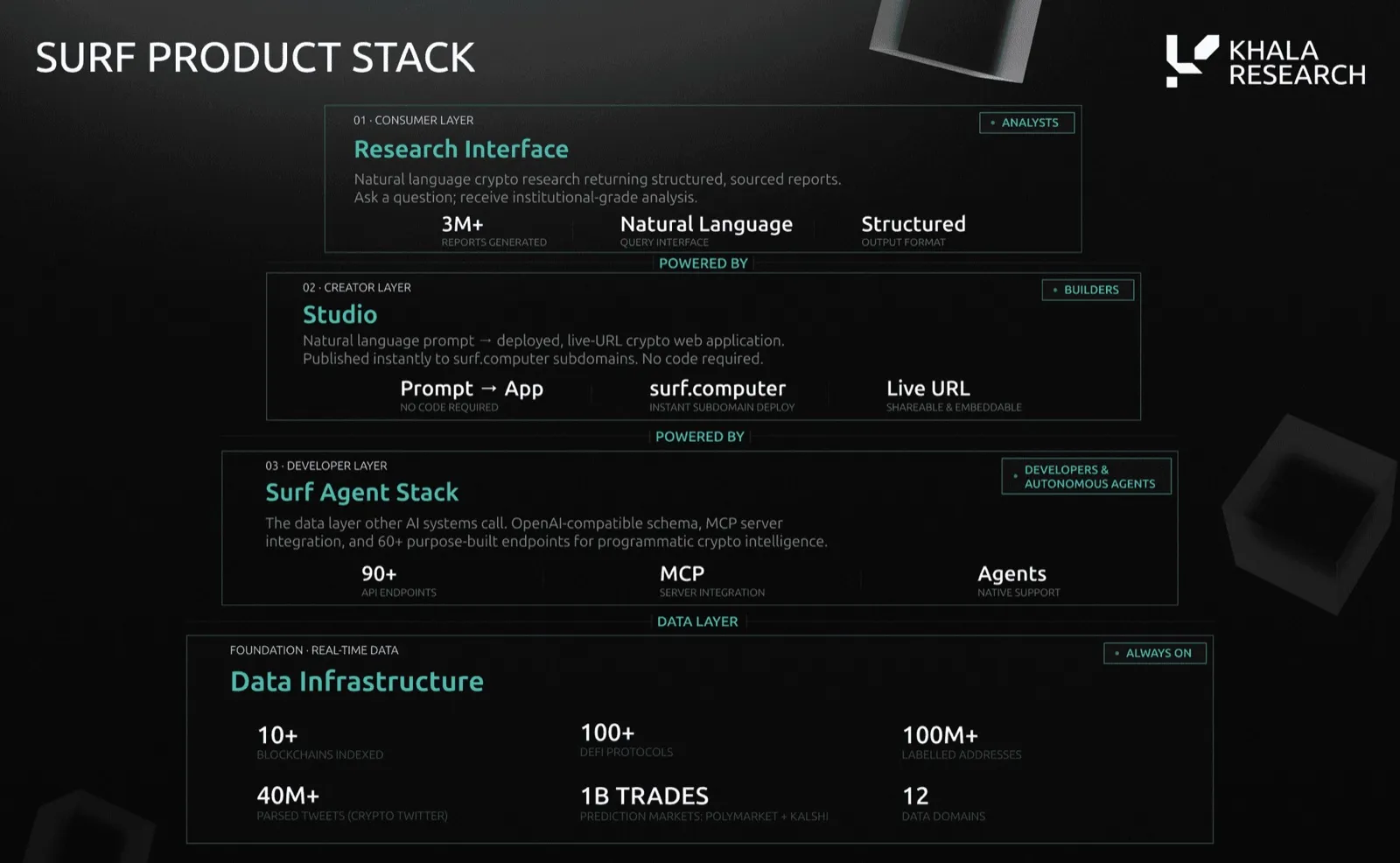
Surf 2.0 introduces two new surfaces that shift the addressable market from individual analysts to developers, builders, and autonomous agents.
Surf Studio
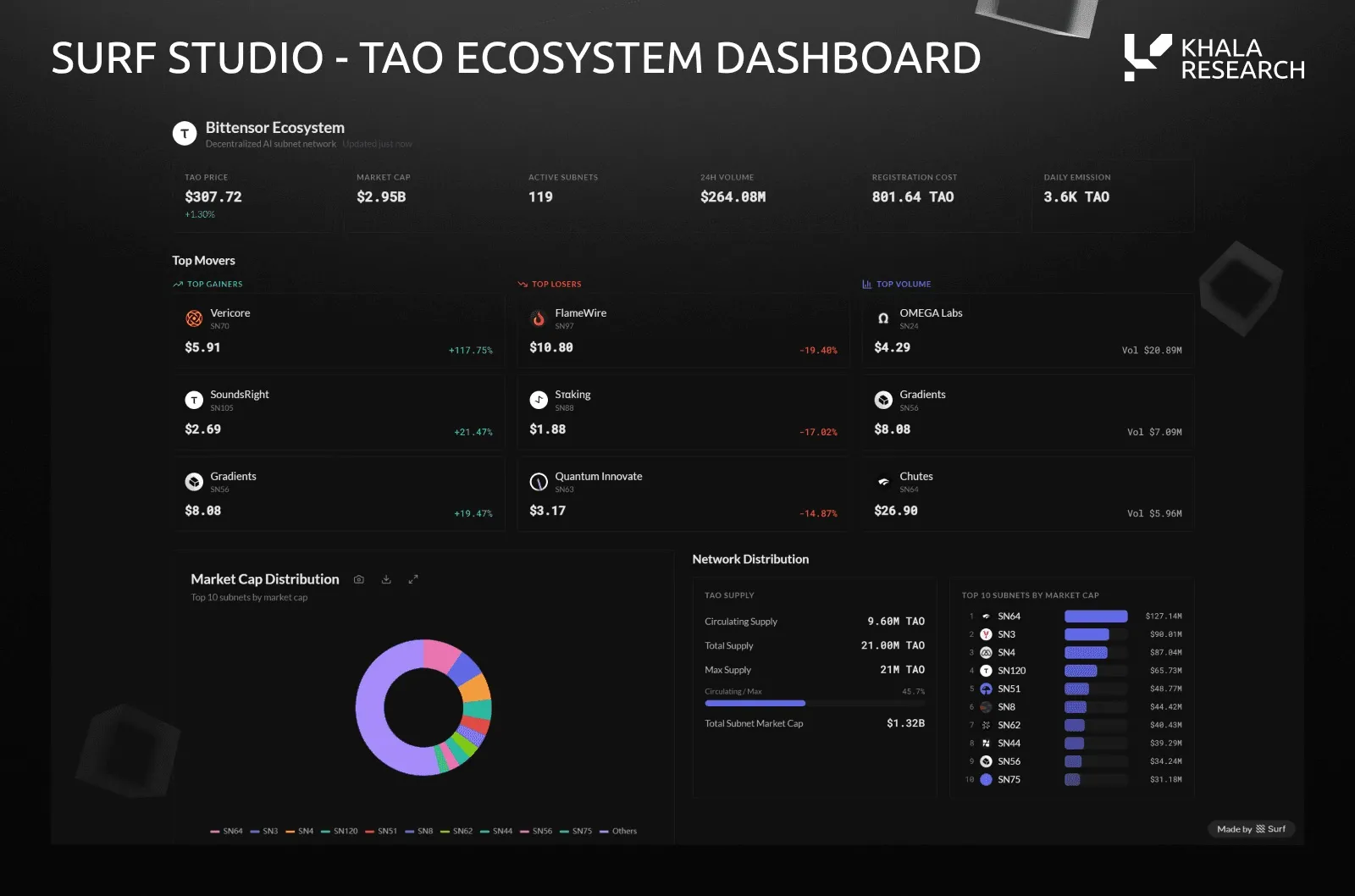
Studio converts natural language prompts into deployed web applications with live URLs at surf.computer subdomains. No code, server configuration or setup required. Apps are production-grade React applications, auto-updating with live data, shareable, and deployable to custom slugs. Deployed sites remain live after the Studio session expires.
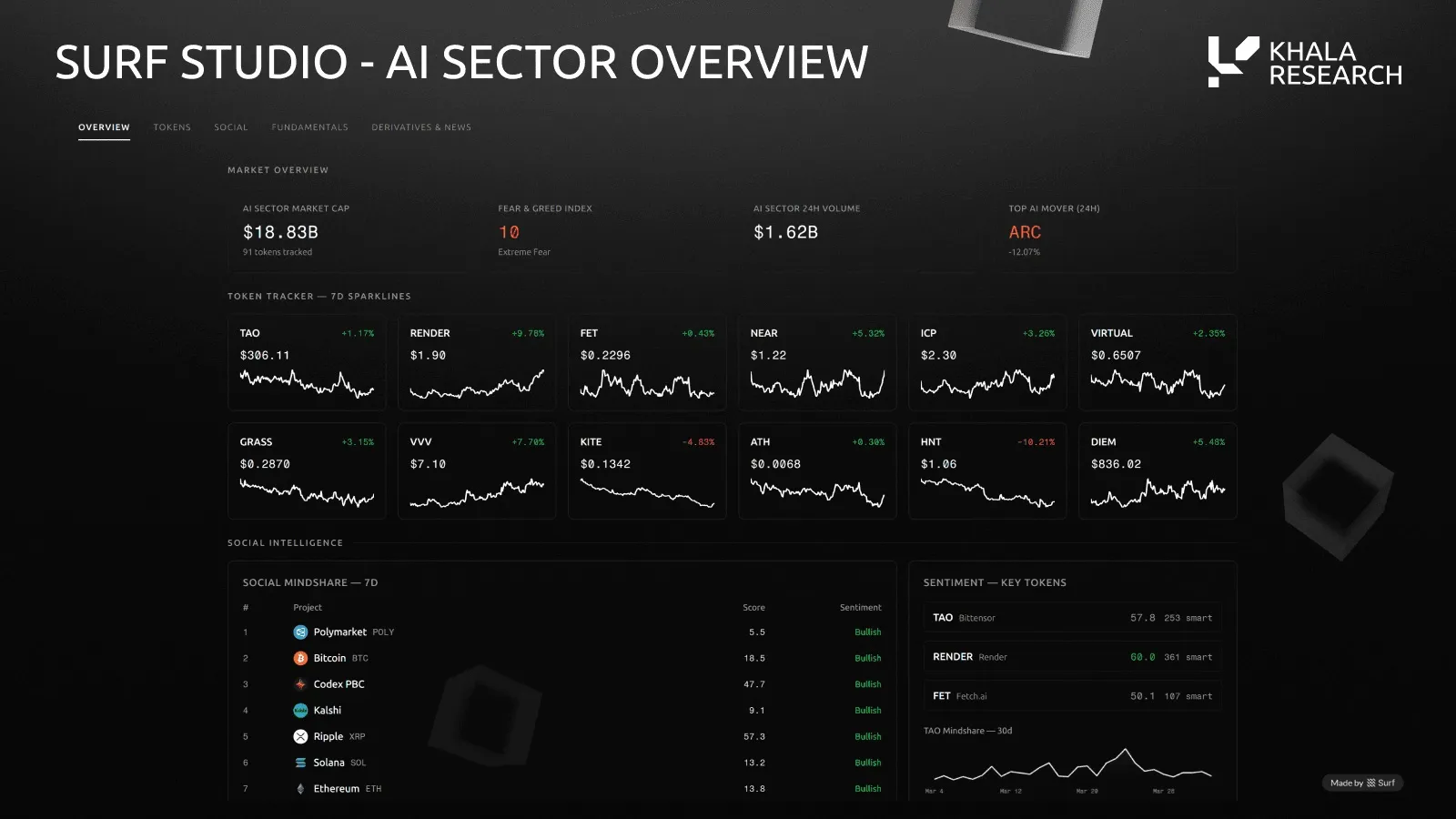
Multiple data source categories power Studio applications: Token Pricing, Derivatives and DeFi, Chain Data (TVL, gas, onchain SQL), Social Metrics, Project Intelligence, and Crypto News. The underlying data layer covers Polymarket and Kalshi prediction market data (~1B trades indexed), 40M+ tweets parsed for social signals, project intelligence with funding and tokenomics data, and onchain analytics across 10+ chains with 100+ DeFi protocols.
Within days of launch, the community had built a 2026 US Midterms election odds map pulling real-time Polymarket data, a Bloomberg-style BTC terminal aggregating price action, onchain flows, and derivatives positioning, a geopolitical alpha dashboard cross-referencing live events with Polymarket, and a Token Buyback and Burn Tracker. Surf's founder, Ryan Li, wrote about the internal shift at launch: non-technical team members, including the head of growth and a marketing intern with no coding experience, were shipping working product dashboards without writing a line of code.
Every application built and shared from Studio carries a "Made by Surf" attribution badge, a minor but compounding distribution asset.
The Surf Agent Stack (SAS)
SAS exposes Surf's data capabilities as developer and agent infrastructure: 90+ API endpoints across 12 data domains (Social, Market, Project, Trading, Wallet, Token, Onchain, Exchange, Onchain SQL, Analytics, Fundraising, Search), packaged as an MCP server and as Skills for Claude Code, OpenClaw, and compatible AI coding environments.
The API is OpenAI-compatible by design: a single POST /v1/chat/completions endpoint using the same schema as OpenAI's Chat Completions API, meaning any agent framework already using OpenAI can substitute Surf's crypto-native models with minimal code changes. As of April 2026, Surf Skills is live and installable in a single command with no API key required to start: 30 free daily credits lower the onboarding friction to zero. A $200K credits campaign at launch subsidizes early adoption, a deliberate play to embed SAS in developer workflows before competing infrastructure ships.
Model Architecture and Orchestration
Surf 2.0 refers to the platform launch (Studio and SAS), not a new model generation. The underlying models are the surf-1.5 family: surf-1.5 (adaptive), surf-1.5-instant (fast/lightweight), and surf-1.5-thinking (deep reasoning). The legacy surf-ask and surf-research models remain available. No surf-2.0 model IDs exist in the API documentation (as of April 2026).
The surf-1.5 generation supports a flat "reasoning_effort" field (low/medium/high), custom tool calls, and Surf-specific ability constraints directing calls to particular data pipelines (search, evm_onchain, solana_onchain, market_analysis, calculate). Configurable reasoning depth is not unique to Surf: OpenAI's Responses API offers equivalent functionality via a nested "reasoning: {"effort": "..."}" parameter for its reasoning models. The differentiation is the crypto-native data pipeline at the other end of the call, not the reasoning routing mechanism itself.
Surf's research interface automatically routes queries based on complexity. From a developer's perspective, Surf presents a single OpenAI-compatible endpoint regardless of which underlying model and data pipeline handles the request.
Data Infrastructure
| Layer | Coverage |
|---|---|
| API Endpoints | 90+ across 12 data domains |
| Exchanges | 16 |
| Blockchains | 10+ |
| DeFi Protocols | 100+ |
| Address Intelligence | 100M+ labeled addresses |
| Prediction Markets | ~1B trades across Polymarket and Kalshi |
| Social Intelligence | 40M+ parsed tweets |
| News | 30+ sources |
| AI Models | Proprietary model family with adaptive routing between instant and deep reasoning modes |
Traction
600K+ total users, 80K MAU, 3M+ research reports.
The 80K MAU against 600K total implies retention consistent with a specialist tool rather than wallet-creation farming. The 3M reports against 600K lifetime users averages 5 per user, consistent with repeat engagement rather than one-time curiosity.
The MAU trajectory deserves direct attention. CoinDesk cited 50% month-on-month growth at the December 2025 raise. Bitget News reported 80K+ MAU in December. The March 2026 figure of 80K represents flat growth over a period that included a $15M raise, a major product launch, and substantial community attention. Arguably more important than raw MAU numbers are paid conversions and retention. Currently, they have 5K+ paying subscribers with a monthly ARPU of $30+, not including enterprise clients.
For additional context on what these numbers mean, Messari is estimated at ~$21.5M ARR with around 120 staff and an institutional-focused pricing model. Nansen reported $9.1M in annual revenue as of December 2024 with 106 employees, down from a peak of 170 staff and $11.9M revenue in 2023. Dune Analytics reported $9.5M revenue with 103 staff. Surf at 80K MAU with ~$3M ARR and fewer than 30 employees implies revenue per user in line with a specialist paid tool rather than a broad analytics platform. The retention ratio is the stronger signal: 5K paying subscribers, 80K monthly active users from 600K total active users since launch last year, without token incentives, is a stronger retention indicator than the absolute MAU figure.
Note: we verified active and total user counts from provided Google Analytics data. Other stats without directly linked sources, such as number of research reports, ARR, ARPU, etc. were provided by the Surf team for inclusion in the report but have not been independently verified.
03Team and Backing
Ryan Li (CEO, co-founder) began building with AI as an undergraduate at UC Berkeley, built two prior crypto startups, and co-founded Cyber with Shiyu Zhang, Wilson Wei, and Zhimao Liu. Cybertino Lab is the internal R&D designation for Surf's AI research arm, as listed in the CAIA paper. The co-founders previously built CyberConnect, a decentralized social graph protocol. Surf AI, Inc. is a distinct corporate entity: new equity, independent cap table, no shared liabilities with CyberConnect. The $15M December 2025 round was raised at and held by Surf AI, Inc. directly. What carries over is operational: technical infrastructure, user base, and the founding team.
The capital efficiency signal is the most analytically relevant team data point. Surf currently reports ~$3M ARR with fewer than 30 employees. If Surf reaches its $10M ARR target with fewer than 30 people, it will be lean by any comparable standard. Whether that leanness reflects efficient product design or a pre-scale phase that will require 3-5x headcount growth to sustain is the question the next six months will answer.
Surf raised a $15M Seed round in December 2025, backed by Pantera Capital (lead), Coinbase Ventures, DCG. Pantera does not lead rounds in consumer research tools with no infrastructure angle. Coinbase Ventures creates a structural pathway to institutional product integration. DCG's broader media and research network provides distribution reach to crypto-native institutional readers. CoinDesk was acquired by Bullish in February 2024. DCG's portfolio and community connections remain relevant; allocators should note that CoinDesk's December 2025 coverage of the raise coincides with DCG's position as an investor in the round.
"Digital asset research has always required a level of context and detail that general LLMs don't handle well. Surf is one of the first teams to take that seriously, and the traction they've shown tells us the market has been waiting for a tool like this."
Nihal Maunder, Partner at Pantera (PRNewswire, December 10, 2025)
04Competitive Landscape
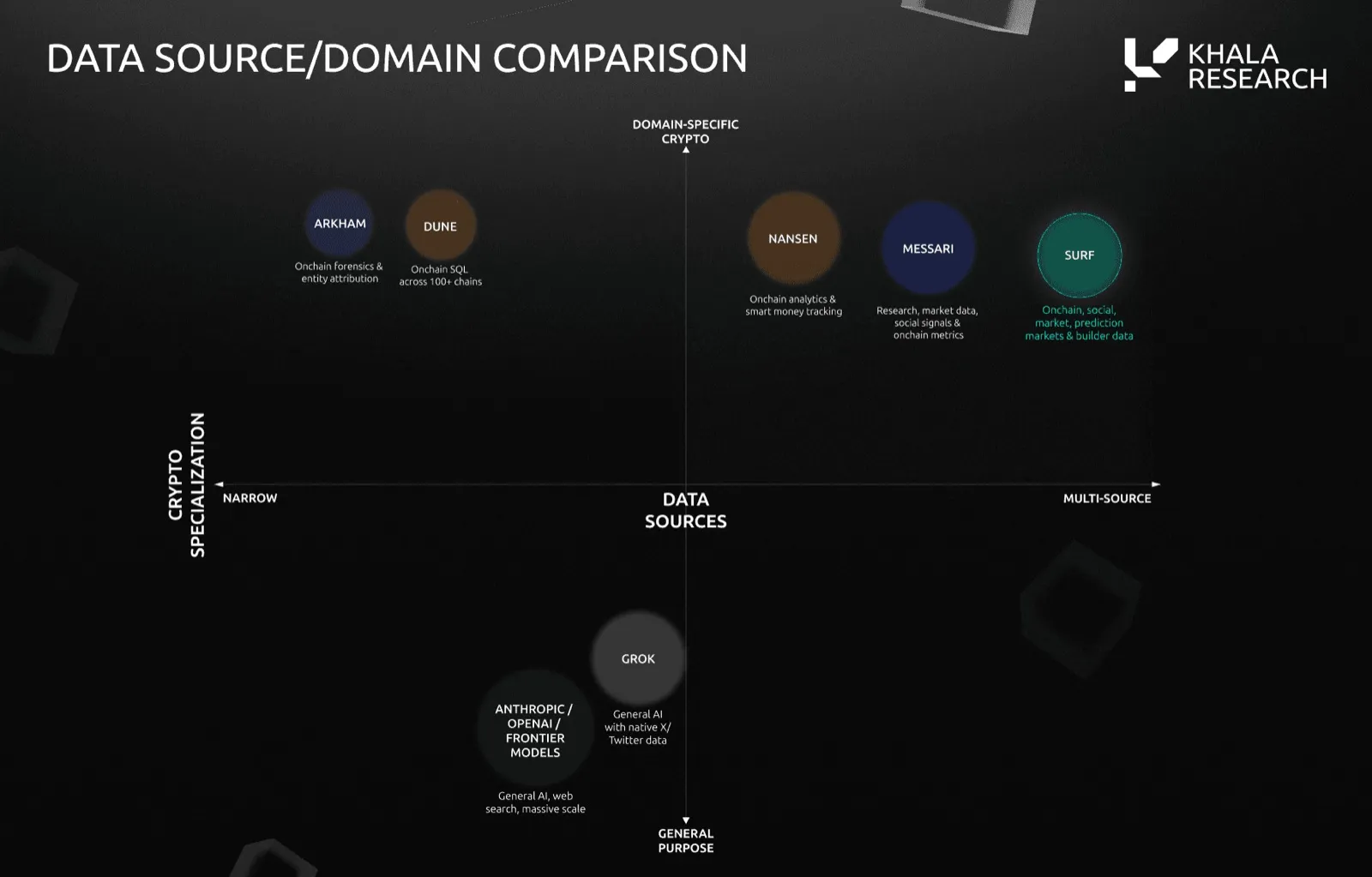
Surf competes across three categories simultaneously: AI-generated research, onchain analytics, and no-code application deployment. This is a distinct position to hold all three data infrastructure layers simultaneously: proprietary social monitoring pipeline, a multi-chain onchain indexer across 10+ networks, and a proprietary model family with domain-specific routing.
Core Crypto AI Comps
| Competitor | Category | Relationship to Surf |
|---|---|---|
| Messari | Data aggregation, institutional research | Institutional research with analyst-written reports and an AI API now packaged as an agent skill for Claude Code and OpenClaw, with x402 pay-per-request access launched March 2026. Estimated $21.5M ARR with ~120 staff. The x402 move repackages Messari's institutional research as pay-per-call retrieval; SAS provides typed data schemas built for agent consumption with MCP-native integration. Different products, different buyers. Messari retains deeper institutional data and KOL mindshare tracking, but lacks Surf's real-time social pipeline and multi-chain onchain routing layer. |
| Nansen | Smart money analytics, AI trading execution | Closest directional competitor. January 2026 Agentic Trading launch (natural language to trade execution, 0.25% fees, Base and Solana) pushes Nansen into the same agentic infrastructure territory SAS targets from the other direction. Nansen's moat: 500M+ labeled wallets, $88.2M raised, $9.1M ARR with 106 staff. Gap to close: proprietary model orchestration, real-time social monitoring pipeline. Replicating all three data layers requires meaningful engineering investment and time. |
| Dune Analytics | Crypto data dashboards, SQL and NL querying | Most credible competitive threat to Studio. Dune has the crypto-native data layer, an established technical user base, $9.5M revenue with 103 staff, and has shipped natural language to SQL querying (late 2024/2025). Reaching Studio-equivalent deployment would require a hosting layer, a non-SQL data layer, and an app framework on top of the existing query interface: a meaningful engineering program, not a feature toggle. Surf's answer to that scenario is attribution library scale and SAS switching costs established before Dune ships. Gap to close: full no-code deployment to live URLs, multi-model orchestration, and a proprietary social monitoring layer Dune does not currently have. |
| Arkham | Onchain forensics, entity attribution, exchange | 2B+ labeled addresses, 92% of onchain value attributed, full exchange (spot and perpetuals). Forensics-first. Head-to-head overlap is minimal; both can coexist in a single analyst workflow. |
| Claude/ChatGPT/Frontier Models | General-purpose AI | Ryan Li's comparison frame: "ChatGPT is a really good generalist, but it doesn't know the crypto industry enough" (Fortune, December 2025). Frontier models form the ceiling of the benchmark documents: 67.4% on adversarial crypto tasks with full tool access. The longer-term risk is frontier model improvement on financial domain tasks specifically, not current performance. |
| Grok | General AI with native X data access | Grok's native X/Twitter integration is a structural advantage on social sentiment relative to other general models. Gap to close: onchain data depth, no-code deployment, agent API infrastructure. The benchmark places Grok in the same accuracy band as other frontier models on adversarial tasks. |
Nansen and Messari represent the two most plausible competitive threats, from different directions. Nansen has the onchain data depth, the engineering resources, and the strategic intent to close the gap on Surf's research interface; building a comparable social monitoring pipeline is a separate program but not insurmountable.
Messari is the more direct SAS threat: its x402 launch opens institutional-grade data to agents on a pay-per-request basis, it is already packaged as a skill for Claude Code and OpenClaw, and a new CEO is explicitly tasked with an AI-first transition. Messari's gap is real-time social monitoring depth and multi-chain onchain routing. Surf's defensive position is SAS integrations already embedded in agent framework defaults; displacement cost rises with scale.
The efficiency gap
Revenue, headcount, capital and productivity by platform.

Annual revenue
- Messari$21.5M
- Dune$9.5M
- Nansen$9.1M
- Surf$3.0M
Employees
- Messari120
- Nansen106
- Dune103
- SurfAbout 30
Capital raised
- Nansen$88.0M
- Messari$61.0M
- Dune$21.0M
- Surf$15.0M
Revenue per employee
- Messari$179.2K
- Surf$100.0K
- Dune$92.2K
- Nansen$85.7K
05Revenue Model
Surf's revenue flows through subscription fees and API credits. The subscription stack runs from Free to Max ($299/month annual), with Enterprise at custom pricing. Max is the gateway to Studio and SAS API access, representing the highest consumer ARPU. Studio operates on a credits-based system; deployed applications persist beyond session expiration, creating permanent outputs from time-limited access. Enterprise API keys are sold separately via direct sales.
Disclosed ARR: Currently ~$3M, with a stated target of $10M by end of 2026. No further revenue disaggregation has been made public.
Surf has no native token. Surf AI, Inc. raised the $15M December 2025 round as its own corporate entity, and revenue flows into that entity. Surf is equity-funded by design. No contractual or governance mechanism directs Surf AI, Inc. revenue to $CYBER token holders, and the team has confirmed none exists. The $CYBER governance token sits within the broader Cyber ecosystem and carries no revenue claim on Surf. The investment expression for allocators is direct equity in Surf AI, Inc.
Pricing
| Tier | Annual (per month) | Monthly | Key Access |
|---|---|---|---|
| Free | $0 | $0 | 1 research/day, limited instant queries |
| Plus | $9 | $15 | 25 research/month, unlimited instant queries |
| Pro | $29 | $39 | 100 deep research per 2 weeks, 1 execution task/day (beta) |
| Max | $299 | $399 | Unlimited research, Studio credits, 1,000 API trial credits |
| Enterprise | Custom | Custom | Dedicated capacity, SLA, custom integrations |
06Catalysts & Risk Factors
Catalysts
- SAS adoption in open-source agent frameworks: SAS is packaged as an MCP server and Skills for Claude Code, OpenClaw, and compatible environments. When a major open-source agent framework documents Surf SAS as a reference crypto data integration, the compounding effect is developer familiarity at scale: the same dynamic by which npm packages become infrastructure defaults. Watch for: Surf Skills GitHub stars and forks as an adoption proxy; SAS appearing in open-source agent project documentation; GitHub integration examples in popular agent repos.
- Enterprise conversion via investor channels: Pantera's LP base, Coinbase Ventures' institutional reach, and DCG's portfolio network create structural pathways to enterprise placement. A named enterprise integration announcement, particularly from the Coinbase institutional stack, would provide the first externally confirmable commercial revenue signal the market can price. YZi Labs' cohort onboarding (confirmed) is the first iteration. Watch for: enterprise tier announcements; named institutional customers.
- SOC 2 certification and Surf Enterprise launch: SOC 2 Type I certification has been approved. Type II is ongoing and scheduled for completion by end of April 2026. Enterprise-grade compliance certification is the gateway to institutional adoption: funds, exchanges, and compliance teams require it before onboarding any data vendor. Type II completion converts Surf from "interesting research tool" to "approvable vendor." Watch for: SOC 2 Type II certification announcement; named enterprise customers.
- COLM submission: CAIA was submitted to ICML 2026 and subsequently submitted to COLM. Acceptance at a top-tier venue would elevate the benchmark beyond the existing AAAI oral acceptance, adding a second layer of independent methodological validation. If CAIA becomes the reference standard for crypto AI evaluation, Surf's team retains structural benchmark advantage regardless of individual model scores.
- Regulatory formalization of agent compliance: Regulatory formalization of compliance requirements for autonomous agent actions in financial markets is an underpriced catalyst. An auditable crypto data layer with source provenance becomes a compliance asset rather than a convenience, and Surf's architecture addresses this requirement before it exists as a mandate. Watch for: regulatory consultation documents on AI agents in financial services.
Risk Factors
- Frontier model improvement is faster than prior estimates: The CAIA ceiling of 67.4% applies to publicly available general frontier models on today's benchmark. Both are moving targets. OpenAI, Google, and Anthropic are explicitly prioritizing domain-specific tool selection as a capability gap to close. Surf's moat is the proprietary data pipeline at the other end of the routing call, not the routing mechanism itself. The question is not if frontier models improve, but whether they reach adequate crypto tool selection before Surf's SAS switching costs become structural.
- Dune's natural language querying is a confirmed competitive threat to Studio: Dune has the crypto-native data layer and a committed technical user base. Confirmed to have launched natural language to SQL querying. Reaching Studio-equivalent deployment would require a hosting layer, a non-SQL data layer, and an app framework on top of the existing query interface. This is a meaningful engineering program, not a feature toggle.
- MAU deceleration is an unresolved signal: ~80K MAU in December to 80K in March is flat over a period that included a $15M raise, a major product launch, and sustained community attention. Whether this is a natural plateau before Surf 2.0 reaccelerates the funnel or a structural ceiling on the research interface's addressable market is not yet determinable.
- Self-certification on CAIA: The benchmark co-authored by Surf's team is the foundation of every product performance claim. AAAI acceptance validates methodology, not Surf's specific figures. CAIA was submitted to ICML 2026 and subsequently submitted to COLM; a non-acceptance at either venue does not invalidate the methodology, but it does narrow the external validation to the existing AAAI oral acceptance. The sharper risk: a competitor independently testing CAIA and outperforming Surf would undermine the core product narrative directly.
- Cyber ecosystem association risk: The corporate separation between Surf AI, Inc. and CyberConnect is clean: independent equity, no shared liabilities, no revenue or IP licensing link. The residual risk is reputational. Allocators unfamiliar with the structure may associate Surf with CyberConnect's prior token dynamics, and the shared founding team means any future CyberConnect controversy creates headline risk for Surf regardless of corporate independence. The mitigation is straightforward: Surf's own revenue traction and institutional backing stand on their own terms.
07Scenario Table
All scenarios are evaluated over a 12-month horizon from publication. Revenue and product milestones are the primary signals.
| Scenario | Conditions | Ecosystem Implication | Monthly Signal to Track |
|---|---|---|---|
| Bear | SAS adoption stalls. No enterprise deal. COLM does not accept the benchmark submission. No MAU growth above 10% over 12 months. Dune ships Studio-equivalent. Token-incentivized competitor reaches comparable MAU. | Surf fails to establish infrastructure defaults. Attribution library does not compound. Narrative repositioning does not hold in market perception. | MAU flat or declining; surf.computer URL library stagnant; no SAS framework citations. |
| Base | SAS achieves measurable open-source agent adoption. One enterprise announcement. COLM accepts CAIA. Studio URL library reaches 10K+ live apps. MAU reaches 150-250K. ARR approaches or hits $10M target. | Surf establishes a credible crypto AI data infrastructure position. Community use cases compound the attribution library. | Month-on-month MAU growth positive; surf.computer URL library growing; one documented SAS integration. |
| Bull | SAS becomes the default crypto data layer in two or more major agent frameworks. Coinbase institutional integration. Benchmark accepted at COLM and cited as reference standard. Studio reaches 50K+ live apps. MAU exceeds 300K. ARR exceeds $10M target. SOC 2 certified. | Surf is the canonical crypto agent data layer. Enterprise revenue provides the first externally confirmable commercial signal. | Named enterprise customer; multiple SAS framework citations; MAU growth above 15% month-on-month. |
08Closing Thesis
Surf has product-market fit. The evidence: organic revenue without token incentives, a ~13% retention rate against 600K total sign-ups, and an investor syndicate (Pantera, Coinbase Ventures, DCG) that does not lead rounds in research chat interfaces. ~$3M ARR with fewer than 30 employees puts Surf in the same revenue band as Dune ($9.5M, 103 staff), Nansen ($9.1M, 106 staff), and Messari (~$21.5M est., ~120 staff) at a fraction of the headcount and capital deployed.
Surf 2.0 is what separates the product thesis from a pure "AI wrapper" narrative. Studio and SAS shift the addressable market from individual analysts to developers and autonomous agents. If SAS becomes the default crypto data layer in agent frameworks, the same way Stripe became the default payment layer, Surf transitions from a product to infrastructure. The SOC 2 roadmap, the enterprise tier, and the YZi Labs cohort onboarding are the first steps in that direction.
The open risks are real: MAU deceleration post-raise, self-certification on the benchmark, and the residual reputational association between Surf AI, Inc. and the Cyber ecosystem. These are questions, not disqualifiers, but they require answers before capital scales in.
The competitive window is open. Nansen has the data depth and strategic intent to close the gap on the research interface. Dune has the technical user base and the data layer to replicate Studio. Messari has opened its institutional data layer to agents via x402 and is explicitly repositioning as an AI-first business. Frontier models improve every quarter.
Crypto AI infrastructure will have a Stripe moment: the point where one data layer becomes so embedded in developer workflows that switching costs exceed the effort to compete. Surf is building toward that moment. Whether it arrives before the competition catches up is the bet.