WALRUS: SOLVING THE AI MEMORY BOTTLENECK

KEY TAKEAWAYS
AI agents are being deployed to millions of users at a velocity that has no precedent in enterprise software. Midjourney hit ~$300M revenue with under 200 employees. Cursor went from $100M to $2B ARR in fourteen months. Deloitte has rolled out Claude to 470,000 staff, Microsoft Copilot serves 20M paid enterprise seats, and the Pentagon operates GenAI.mil for 1.5M daily users. Revenue per employee at AI-native companies has no precedent in business formation.
Memory debt is one of the biggest blockers to mass market enterprise agent adoption. Context windows grow larger but remain stateless. Every API call starts from zero, and an enterprise running one hundred agents loses institutional knowledge with each conversation end. The cost of re-teaching compounds non-linearly. The frameworks solve how to build agents but what agents remember across sessions remains unsolved.
Agent memory has no verifiable provenance. Centralised memory providers compete on retrieval speed and developer convenience. They enforce access rules through terms of service. Auditability, cross-model portability, and cryptographic proof of integrity require building from the storage layer up. They are available only when the storage layer itself is programmable.
Over $57M has been deployed into external agent memory, a category that did not exist in 2024. The funding has gone to parallel bets on centralised convenience, self-hosted control, and knowledge-graph architectures. No single approach has emerged as the default.
EXECUTIVE SUMMARY
A company's customer history is trapped when it changes AI providers. The new agent has no memory of what the old one learned and every session ends with a wipe. The agent that resolved a billing dispute yesterday has no record of the policy exception it granted. The code review agent that caught a security flaw last week does not remember the pattern it found. This is agent memory in 2026. For regulated industries, this problem has a deadline. The EU AI Act requires high-risk AI systems to maintain automatic event logging and traceability under Article 12. Deployers must also retain those logs for at least six months under Article 26. Enterprises will need proof of what data an agent accessed. Centralised providers store that data but they cannot prove the record was unchanged.
Walrus Memory stores agent memory on decentralised storage with programmable access control on the Sui blockchain. Access control is enforced by Move smart contracts, not by a platform's terms of service. Provenance is verified by onchain hashes, and ownership is tied to a cryptographic key pair, not a user account, making it portable across model providers. The SDK connects via MCP to any MCP-compatible tool, such as Claude Code, Cursor, Codex, or OpenClaw. At the time of publishing, no enterprise pilot has been announced but the product is under a month old.
This report evaluates whether protocol-enforced trust properties can convert to enterprise adoption before centralised alternatives close the feature gap. It maps the AI agent landscape, the memory layer, Walrus Memory's architecture and deployment paths, and the competitive market for agent memory.
1. THE AGENT TAKEOVER
Software has been one of the most powerful force multipliers for half a century, extending human capability across industries and borders. The corporation as an organisational form was built to coordinate human labour at scale, and for the first time in its history, companies can operate on a fundamentally different cost structure by deploying AI agents.
AI agents are collapsing the distance between idea and execution. A company running ten agents per worker can outperform a competitor through compounding knowledge that outpaces what human teams can match. Every function that defined the modern enterprise, from legal review and market research to engineering, operations, and customer support, is being rebuilt on this assumption, and the companies that moved first are producing numbers that were not possible in the previous era of business formation:
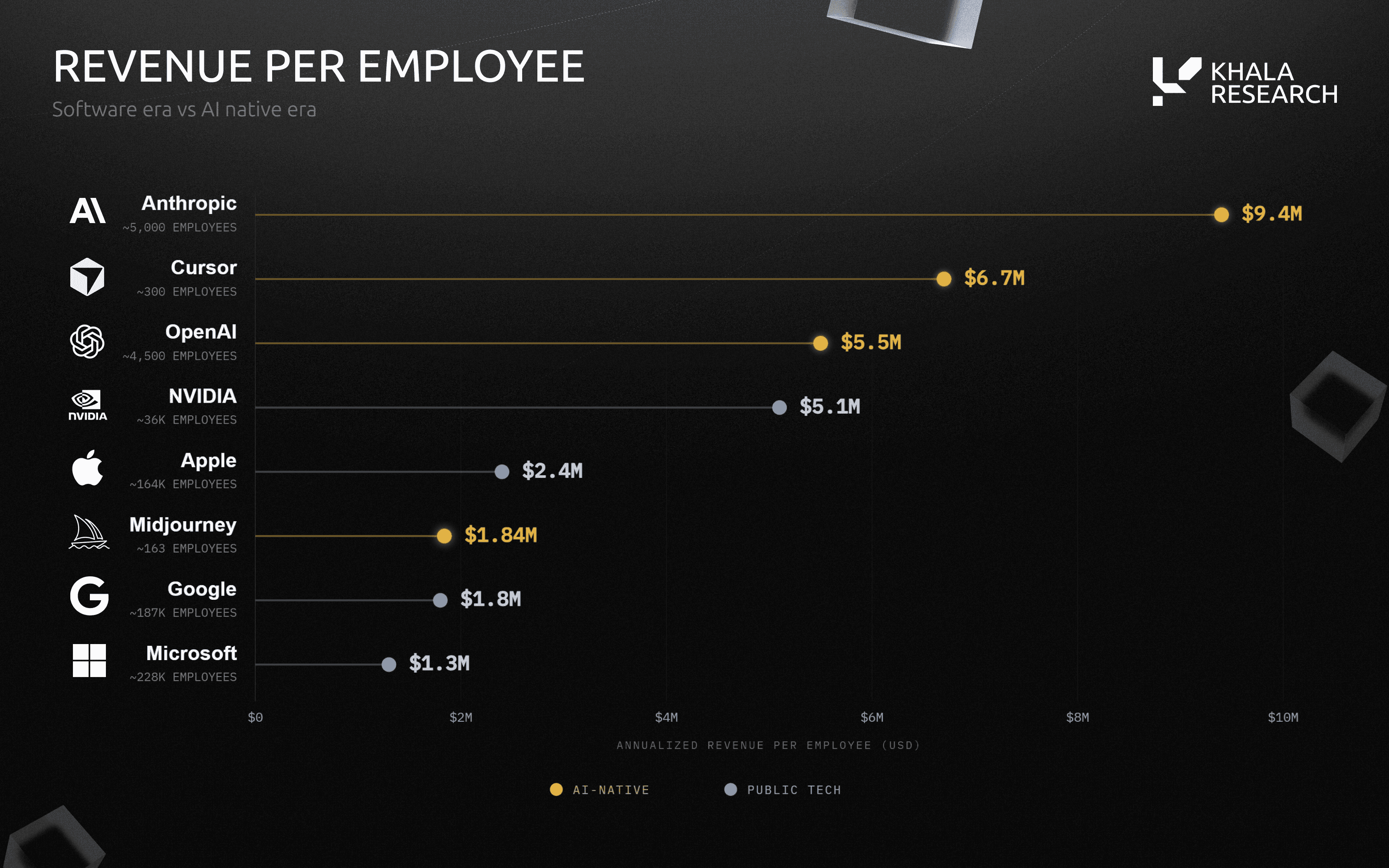
Midjourney: an estimated $300M in revenue in 2024 with fewer than 200 employees, entirely self-funded with no external venture capital, built on a product that did not exist three years ago.
Cursor: grew from $100M to $2B in annualised revenue in fourteen months, raised at a $29.3B valuation in November 2025, scaled from 20 to over 300 engineers in the same period.
ElevenLabs: surpassed $500M in annualised recurring revenue by May 2026 with 530 employees and an $11B valuation, with enterprise revenue growing 200% year-on-year as voice AI replaces human narration, localisation, and customer service infrastructure across industries.
Each technological era produced a step-change in revenue per employee. The AI-native era produced the largest gap yet.
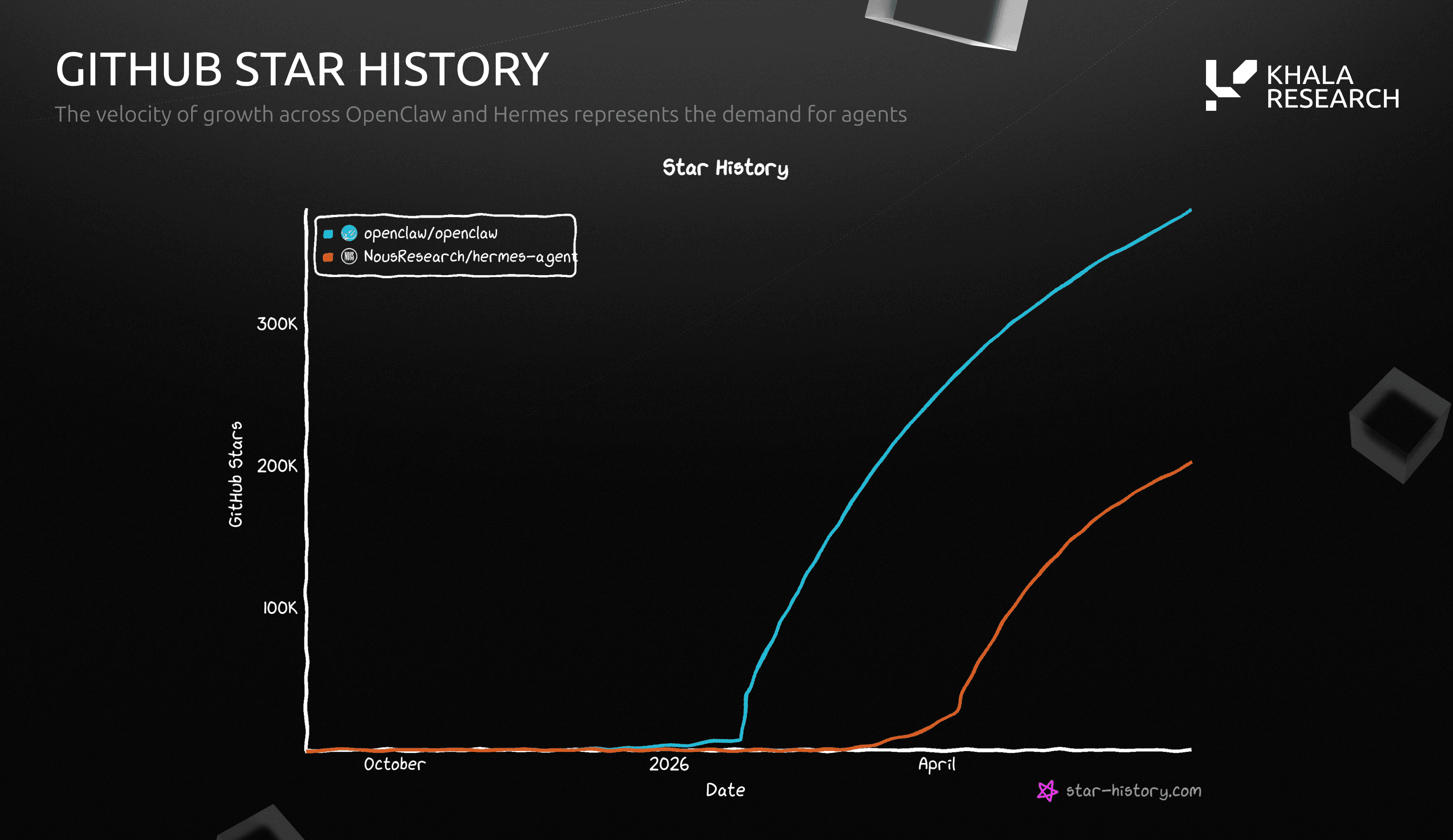
The infrastructure these agents run on has reached adoption velocity that signals a shift in how software is built. A GitHub star is a composite signal: developers use it to bookmark a repository and to show appreciation for the maintainer's work, and GitHub's own rankings partially weight star volume when surfacing projects. For developer infrastructure, rapid star accumulation functions as a real-time proxy for mindshare. The velocity matters because infrastructure choices are sticky; the frameworks that developers endorse today become the default integration targets that enterprises depend on tomorrow. React held the title of most-starred non-aggregator software project on GitHub for years, accumulating 243k stars. OpenClaw surpassed it in under four months and now sits at 380k stars. NVIDIA wrapped it in a security layer called NemoClaw and assembled 17 enterprise launch partners including Adobe, Salesforce, SAP, ServiceNow, and Palantir. Hermes Agent has accumulated 202k stars in five months (the repo is older as it was private until February). Every developer building on these frameworks will eventually hit the same wall: the agent cannot remember what happened in the last session. The frameworks solve how to build agents. What agents remember remains unsolved.
Enterprise deployment has matched this velocity. Gartner predicts 40% of enterprise applications will feature task-specific AI agents by the end of 2026, up from less than 5% in 2025. Microsoft reports over 20M paid Copilot enterprise seats, Deloitte has rolled out Claude to more than 470,000 staff, and the Pentagon's GenAI.mil platform serves 1.5M daily users. The stakes shift with scale. A bad chatbot response costs nothing. A bad agent that executes a trade, updates production code, or sends a contract is hard to reverse.
Jensen Huang identified this gap at CES 2026 in January: "Context is the new bottleneck - storage must be rearchitected." NVIDIA launched the NVIDIA Inference Context Memory Storage Platform at the same event.
An investment analyst who has spent three years covering a sector does not re-read introductory materials before every meeting. They have built judgment, pattern recognition, and experience that compounds over time. An agent that forgets everything at session end starts from zero every morning. An enterprise running ten agents loses institutional knowledge with each conversation end. At one hundred agents, the cost of re-teaching compounds. This is “memory debt”.
2. THE MEMORY IMPERATIVE
Every API call to a large language model is stateless. The context window resets with each new session, and an agent handling a support ticket at 9am has no memory of the customer's previous complaint at 3pm yesterday unless the developer manually injects that history into the prompt. Context windows have grown to 1M tokens, figures that suggest huge recall ability but mask a design flaw. In long conversations, the model's attention concentrates on the beginning and end of the text, underweighting the middle. An agent that cannot distinguish whether a billing dispute was resolved last week or six months ago cannot reason about what to do next.
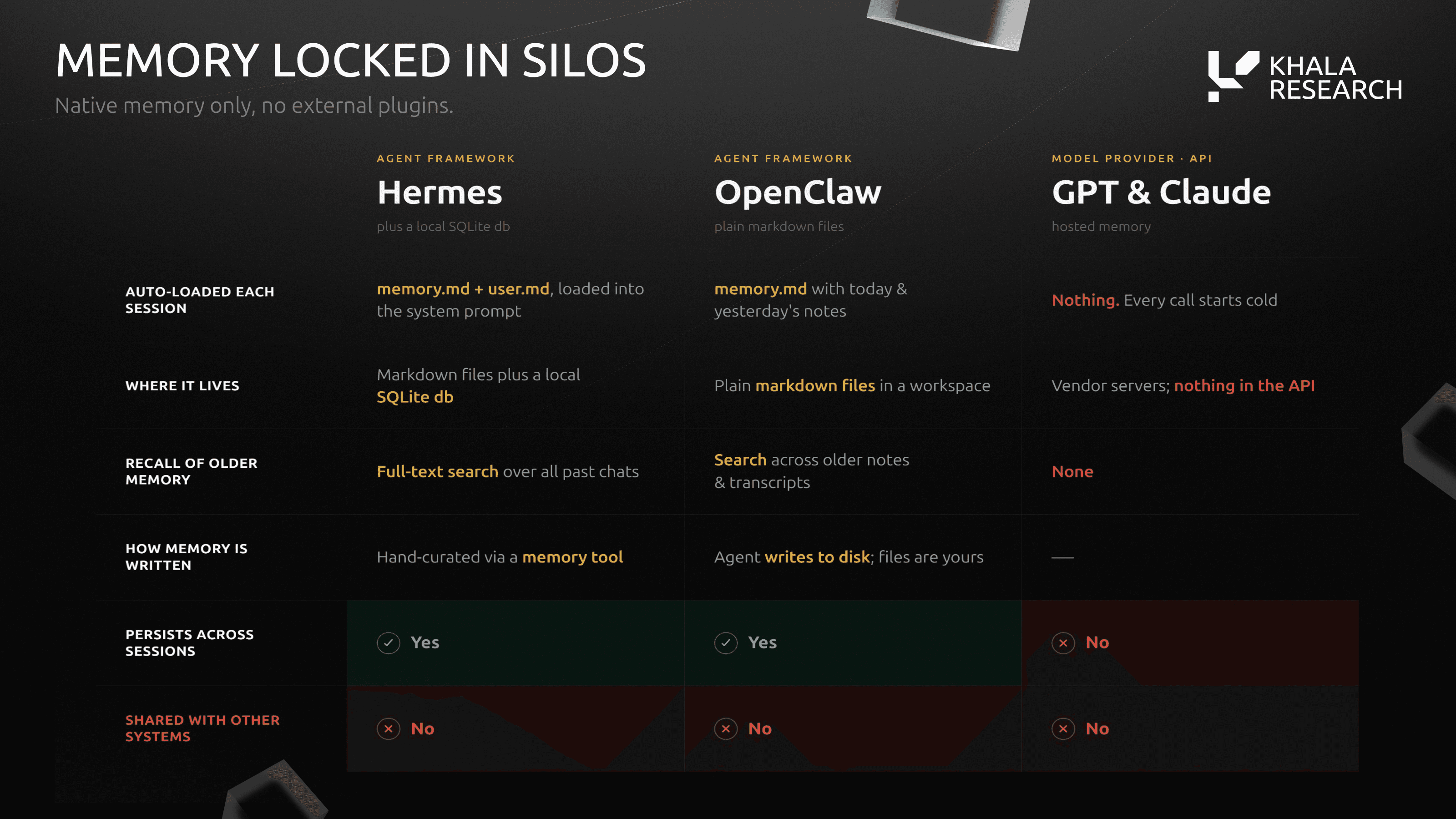
The first workaround developers reach for is Retrieval-Augmented Generation, or RAG. RAG retrieves relevant documents from a collection and injects them into the prompt at query time. It works when the answer already exists in a document the organisation owns: a policy manual, a product spec, a compliance framework. It fails when the information exists only in the interaction itself: that a user prefers brief summaries, that the last three support tickets escalated over a billing dispute, or that security approved an approach on Tuesday and reversed it on Thursday. Matt Kruczek, Managing Director of Digital Engineering at EY, drew the distinction: RAG retrieves what you already knew. Memory records what the agent has learned.
The AI labs have built basic memory into their consumer products, but not into their infrastructure. ChatGPT has consumer-grade memory that extracts shallow facts from conversations and stores them as bullet points. Claude memory is more advanced, with automatic synthesis and manual fact injection, but remains a consumer-profile feature with a roughly 24-hour synthesis delay and a 100KB cap in the managed agents beta. Neither offers cross-session persistence via API, verifiable provenance, or cross-model portability.
The agent memory market is forming around this gap. Eight dedicated memory providers have raised ~$57M in disclosed funding collectively. Mem0 leads with $24M, Letta raised $10M and Cognee raised €7.5M for memory with a cognitive-science ontology. The remainder includes Plastic Labs, Vectorize, Supermemory, Potpie AI, and Zep AI. Their common approach is centralised storage, managed hosting, and API-key access. They solve developer convenience but the enterprise trust problem remains open.
What enterprises need is different. Cross-session persistence means an agent remembers a billing dispute across three support tickets and two model upgrades, not starting each interaction from zero. Auditability means a regulator can see exactly what context was provided to an agent on a specific date, with proof the enterprise did not construct the record after the fact. Portability means memory moves when the enterprise switches model providers without vendor negotiation or data retraining. Verifiability means cryptographic proof that stored data was not tampered with between write and read. Centralised platforms enforce access rules through terms of service. Protocol-based storage enforces them through code.
A credit applicant's legal counsel requests the full decision record. The enterprise produces Mem0's logs showing what the agent read and when. Counsel asks whether those logs could have been modified without detection. The institution cannot independently demonstrate that the record was unmodified. The vendor is a witness to its own records. At enterprise scale, the exposure compounds: a single modified record poisons every downstream decision across every agent that acted on it.
A Docker survey of 800+ developers and technology decision-makers found that 76% report active concerns about vendor lock-in. The most damaging form is what MindStudio calls behavioural lock-in: the accumulated operational knowledge an agent builds about an organisation that exists only inside the vendor's system. A procurement agent that has spent six months learning internal approval workflows, signatory requirements, and exception histories carries that knowledge only within its current platform. Switch platforms and that accumulated context is gone.
Regulated enterprises need compliance properties that are built into the architecture, not guaranteed by contract. SOC 2 certifies a platform's systems, not the integrity of data stored in them. Terms of service change with 30 days' notice. Data residency commitments are vendor promises. No centralised provider gives an institution independent, cryptographic proof that its agent records were not tampered with. That proof has to be built from the storage layer up.
3. THE WALRUS ORIGIN
Kostas Chalkias, Chief Cryptographer of Mysten Labs, on the Supercycle Podcast
Mysten Labs was founded in September 2021 by five researchers and engineers from Meta's Diem and Novi divisions:
Evan Cheng: Co-Founder and Chief Executive Officer. Previously Director of Engineering at Meta, leading Programming Languages and Runtimes and later directing R&D at Novi Financial. Earlier, Senior Manager at Apple, where he co-developed the LLVM compiler infrastructure. Recipient of the ACM Software System Award.
Sam Blackshear: Co-Founder and Chief Technology Officer. Previously Principal Engineer at Meta, where he created the Move programming language and worked on the Diem platform's smart contract architecture.
Adeniyi Abiodun: Co-Founder and Chief Product Officer. Previously Product Lead for crypto infrastructure at Meta, leading R&D on the Diem Network and Move programming language. Earlier, Head of Product for Blockchain at VMware and Architect for Blockchain Cloud Platform at Oracle.
George Danezis: Co-Founder and Chief Scientist. Professor of Security and Privacy Engineering at University College London. Previously Research Scientist at Meta on the Diem payment network. Co-designed the Sui smart contract platform and Narwhal/Tusk consensus protocols.
Kostas Chalkias: Co-Founder and Chief Cryptographer. Previously led cryptography for the Diem project and was senior staff researcher on WhatsApp security at Meta. Earlier, Lead Cryptographer at R3, architecting Corda's cryptographic systems.
Collectively, the team built the cryptographic infrastructure for Meta's Diem (formerly Libra) and Novi before the Diem project was shut down. The team brought roughly two decades of combined systems and cryptography research to the project.
The team's first product was Sui, a layer 1 blockchain launched in May 2023. Sui's distinguishing feature is its object model. On Ethereum, assets exist as entries inside smart contracts. On Sui, every asset is an object with a unique identifier, an explicit owner, and a type. Ownership is protocol-level, not contract-logic dependent. The chain itself knows who owns what. This makes programmable access control native rather than an add-on. Sui is programmed in Move, a resource-oriented language developed at Meta for the Diem project and adapted by Mysten Labs. In Move, assets have rules about whether they can be copied, moved, or destroyed, enforced at compile time.
The team needed storage that could leverage its programmable object model. So they built Walrus, a decentralised storage network that launched on mainnet in 2025. Walrus pairs each storage operation with a Sui transaction, meaning access control, data expiration, and permissions are enforced onchain rather than by a terms of service document. Mysten Labs also built Seal, a threshold encryption protocol launched on mainnet in September 2025, where access rules are enforced through smart contracts and no single party, including Mysten Labs, can access stored data without meeting the onchain conditions. That same architecture, where access rules are code not contracts, is what makes verifiable agent memory possible. In June 2026, the team launched Walrus Memory, extending the base storage layer with semantic search, Seal encryption, and programmable access control designed for AI agents.
Walrus raised $140M in a token sale in March 2025, led by Standard Crypto with participation from a16z Crypto, Electric Capital, Franklin Templeton Digital Assets and other investors with the round valued at $2B.
4. WALRUS MEMORY

Kostas explaining what makes Walrus Memory unique
AT A GLANCE
Category: Agent memory
Key properties: Verifiable provenance, portability, programmable access control
Primary risk: No independently verifiable enterprise traction; product launched June 2026
Watch for: Named enterprise pilots, third-party integrations, protocol revenue
Walrus Memory stores what an agent learns on decentralised infrastructure where access rules are enforced by smart contracts. For an enterprise, this means an agent's memory can be audited by a regulator, ported across model providers without vendor negotiation, and cryptographically proven to have not been tampered with between write and read. Building these properties into a centralised architecture would require rebuilding from the storage layer up. Walrus has them by design.
The product competes on four properties that centralised systems have not replicated.
Portability. Memory is owned by a wallet address, not by a platform account. An enterprise can migrate an agent's memory from Claude to ChatGPT to an open-source model without vendor negotiation, export fees, or format conversion. The memory object belongs to whoever holds the private key.
Programmable Access Control. Access rules are encoded in Move smart contracts, not in a platform's policy engine. A developer can program conditions that static access control cannot replicate: grant access upon proof of payment, restrict to specific wallet addresses, limit to certain hours or days, or bind to external conditions such as a token price threshold. A compliance team can encode rules that auto-expire data after a regulatory retention period ends. The contract revokes decryption keys automatically.
Verifiable Provenance. Every memory blob is registered on Sui with a cryptographic hash. A regulator can verify that the context provided to an agent on a specific date was exactly what was stored, with proof that the data was not tampered with between write and read. The proof is a cryptographic record on a public blockchain, not an audit log maintained by a vendor.
Cross-Agent Coordination. Because memory is stored in shared memory spaces exposed through APIs, multiple agents can read from and write to shared memory without trusting each other or the storage provider. A scheduling agent writes an appointment to shared memory. A billing agent reads it and generates an invoice. A compliance agent verifies the meeting was documented before the invoice was sent. None of the three agents need to trust each other or the storage operator. The state is onchain, the APIs are standardised, and the access rules are enforced by code.
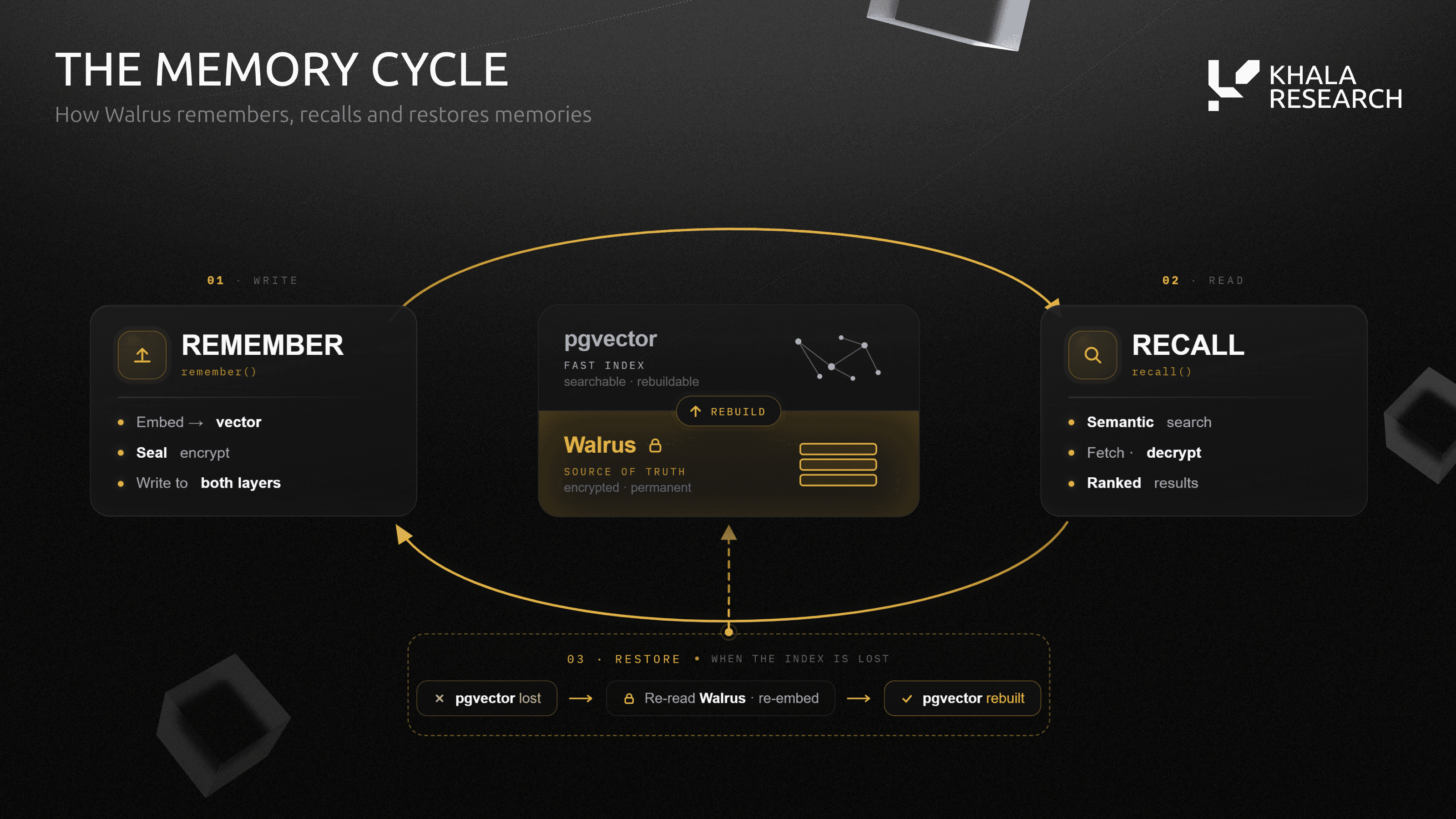
The product delivers these properties through three core functions:
Remember takes any text, embeds it for semantic search, encrypts it with Seal, and writes it to Walrus storage with a content-addressed signature proving exactly what was stored and when.
Recall lets an agent query stored memory using natural language, returning results ranked by semantic meaning rather than keyword matching.
Restore rebuilds missing index entries from onchain data if a relayer loses its index, self-healing the agent's memory without manual intervention.
The architecture has four layers. At the top, the Walrus Memory SDK handles the developer interface. Below it, a relayer manages encryption, embedding generation, and vector indexing in PostgreSQL. Below that, Seal handles threshold encryption before data reaches Walrus storage. At the base, Walrus stores the encrypted blobs and Sui registers ownership, access rules, and cryptographic proofs. Seal uses threshold encryption with user-controlled keys, enforced through Move smart contracts on Sui.
The Walrus Memory SDK provides Python and TypeScript interfaces with native MCP support, plugging into Claude Code, Cursor, Codex, Gemini CLI, and any MCP-compatible tool. First-party plugins exist for OpenClaw and NemoClaw.
Walrus storage uses RedStuff, an erasure coding protocol that splits files into redundant fragments so the original can be recovered even if nodes fail. Full technical specifications are in the Walrus docs and the formal proofs in an arXiv preprint. Quilt, launched in July 2025, batches small files into single storage units, reducing costs by up to 400x for 10KB files. Agent memory files and embedding vectors are typically small, which makes Quilt relevant to the economics of running an agent on Walrus Memory.
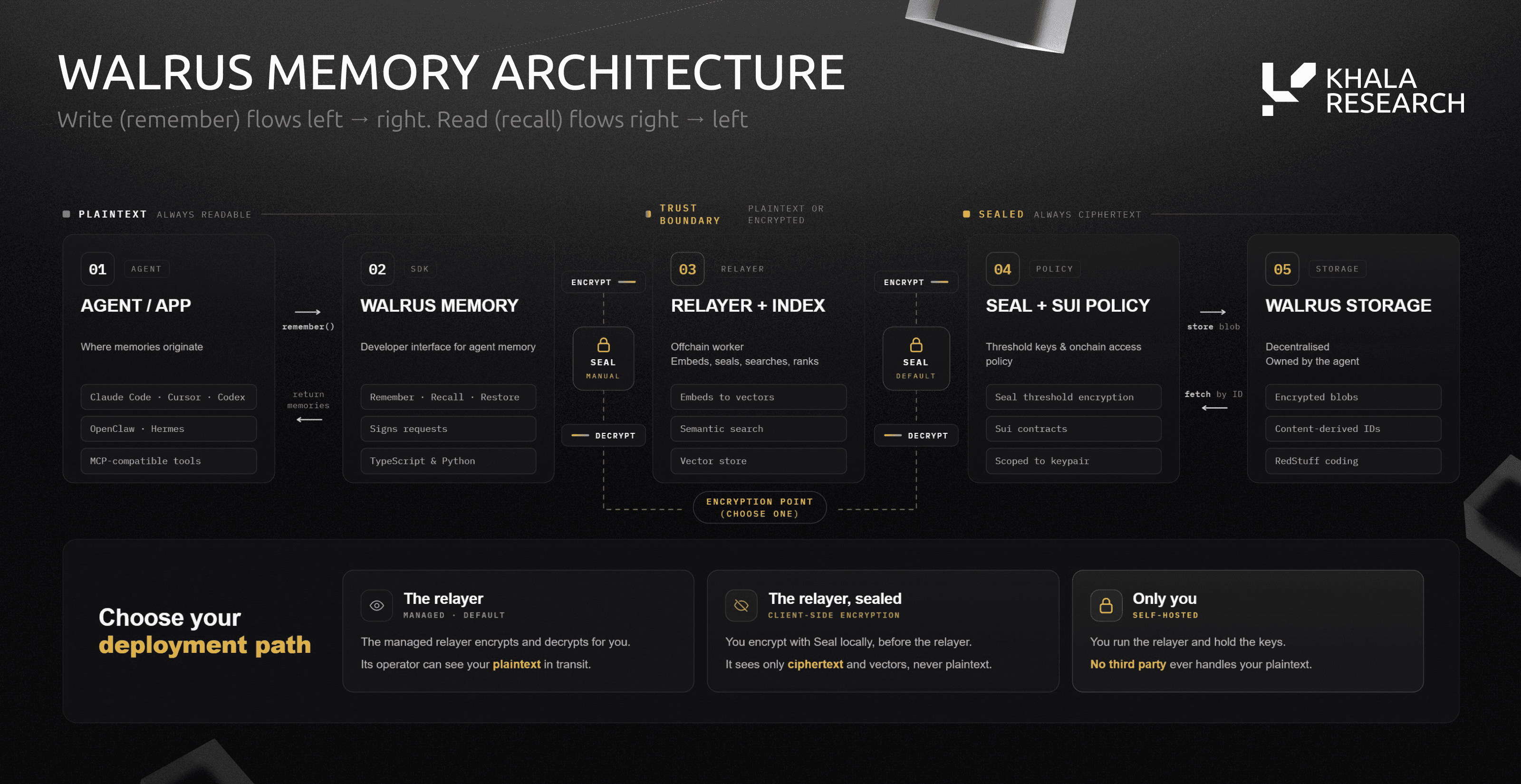
Deployment Paths
Users have three deployment options, which sit on a spectrum from convenience to control.
Managed (default). This is the fastest path to deployment. A developer installs the SDK, signs in with Google or a wallet, and the managed relayer handles everything else: embedding generation, Seal encryption, Walrus blob upload, and vector indexing. This option has been made free during the launch period. There is currently no charge to the user for storage, gas, Sui transactions, or embeddings. Setup takes minutes and requires no blockchain expertise.
The tradeoff is privacy. The managed relayer handles both encryption and decryption during normal operation, which means the relayer operator can see plaintext memory content in transit. This is the same privacy model that other memory providers operate under. The difference is what you get in return: verifiable provenance, portability, and programmable access control that are built into the protocol rather than enforced by terms of service.
Managed with client-side encryption. For teams that want additional privacy without deploying their own infrastructure, the Walrus Memory SDK supports a manual client flow where the user handles Seal encryption locally before sending data to the relayer. The relayer still manages upload relay, vector registration, semantic search, and restore, but it sees only encrypted payloads. It never sees plaintext.
This means your raw data never leaves your machine unencrypted. The relayer cannot read your memory content. The tradeoff is that the relayer still handles search and restore, which means it sees vectors (semantic fingerprints used to find relevant memories) even though it cannot read the plaintext. You also need to provide your own OpenAI-compatible embedding API key and manage Seal encryption client-side. Walrus storage and SUI gas are also currently subsidised during the launch period, so the only cost is your embedding provider. This is the right choice for teams that want a middle ground between convenience and privacy, or need encrypted payloads for audit purposes, but are not ready to self-host.
Self-hosted. For users that want full control of their data and complete privacy, the relayer can be deployed on their own infrastructure. This means running the Rust relayer plus TypeScript sidecar, PostgreSQL for vector indexing, and optionally an indexer. The user controls the entire trust boundary: embedding provider selection, data isolation via separate package IDs, and horizontal scaling across multiple relayer instances.
No plaintext is ever exposed to Walrus infrastructure. The user runs the relayer, the user holds the keys, and the user manages the encryption. This is the only option where no third party handles plaintext, producing an auditable data trail from end to end. For teams subject to strict regulatory requirements, this is the only deployment path where compliance is verifiable from end to end. The cost shifts from subsidised to self-funded. The user pays $WAL storage fees at $0.023/GB/month, Sui transaction gas for every onchain operation, and infrastructure overhead. They must manage wallets, acquire tokens, and maintain the deployment. Horizontal scaling is supported via shared PostgreSQL and Redis clusters, but this requires operational expertise that the managed paths do not.
The right choice depends on what the user is optimising for. Managed hosting delivers verifiable provenance and portability in minutes, with no infrastructure burden. The privacy tradeoff is the same one every centralised provider asks for. Client-side encryption adds a privacy layer for teams that need encrypted payloads for compliance, without the operational overhead of self-hosting. Self-hosting is the only option for users who need full control of their data and cannot depend on infrastructure they do not control.
The knowledge required varies by path. Managed requires no blockchain familiarity. Client-side encryption requires understanding of Seal encryption and embedding APIs. Self-hosting requires wallet management, token acquisition, and operational knowledge of Sui and Walrus. Latency also differs: the p95 end-to-end recall latency is 1.5-3 seconds, which includes vector search, blob retrieval, and Seal decryption. Raw blob download is ~800ms. This is slower than centralised alternatives, and it is the tradeoff for verifiability and encryption.
Three weeks after launch, early adoption exists but enterprise traction does not. The Walrus team reports ~3,500 unique agent owners and ~73,000 blobs written since launch. Teams integrating Walrus Memory at launch include Allium, Conso Labs, Inflectiv, OpenGradient, Talus Labs, and Tatum. ElizaOS has integrated Walrus as its default data platform for agent memory. MCP plugins extend support to Claude Code, Codex, Cursor, and Aider. The Walrus platform stores ~2300TB with 59% capacity utilisation as of June 2026. The Walrus Memory SDK repository is publicly available on GitHub.
What exists is architecture, SDK, launch partners, and early developer adoption. What does not exist yet is evidence of enterprise demand at scale.
Economics
Walrus protocol charges $0.023 per gigabyte per month for storage, matching AWS S3 Standard at the headline rate. Unlike S3, the price includes programmable access control, verifiable provenance, and cross-platform portability. Unlike Arweave, which uses a one-time endowment model with no ongoing fees, Walrus charges recurring fees, creating sustained demand for $WAL. Users prepay into a storage fund held in Sui smart contracts, with payments distributed to storage nodes at epoch end based on performance.
$WAL is the Walrus platform token. Maximum supply is 5B tokens, with approximately 48% currently circulating. $WAL trades at ~$0.03 with a market capitalisation of ~$82M, down from its May 2025 peak of $0.76. Institutional exposure exists via the Grayscale Walrus Trust, launched in June 2025. Storage fees are denominated in USD but settled in $WAL, meaning the amount adjusts automatically as the token price fluctuates. Users who want to store data must purchase $WAL, creating buy pressure that scales with adoption.
$WAL has deflationary burn mechanisms in place. A portion of per-transaction fees is burned at epoch change. Slashing penalties and stake-shift penalties also remove WAL from circulation permanently. Value accrual to WAL is demand-driven. Gross revenue is retained as protocol/treasury revenue. No direct revenue share to holders exists. Staking rewards are funded by storage fees and protocol subsidies. The token's value depends entirely on storage demand materialising. If demand grows faster than sell pressure from node operators and uncirculated supply entering the market, $WAL appreciates. If it does not, the price likely declines regardless of product merit.
5. COMPETITIVE LANDSCAPE
Gartner forecasts that 40% of enterprise applications will feature AI agents by the end of 2026, up from less than 5% in 2025. The Business Research Company sizes the broader agentic AI orchestration and memory systems market at $9B in 2026, growing at 38.7% CAGR to $33.5B by 2030. The $9B figure bundles orchestration frameworks, memory layers, workflow engines, observability, and testing tools. Memory is a subsegment within it. The standalone agent memory segment is estimated to be at $1.28B in 2026, growing to $2.45B by 2034 at 7.8% CAGR.
Eighteen months ago, agent memory was not a category. Mem0 launched in 2023 as a drop-in memory layer and stood largely alone. The AI labs treated memory as a consumer convenience, not infrastructure. ChatGPT stored user preferences as bullet points. Claude offered automatic synthesis with a 100KB cap. Both were profile features for individual users, not persistent storage for enterprise agents. The gap created space for dedicated providers. Multiple providers now offer different types of memory: semantic search, temporal facts, self-improving blocks, knowledge graphs, reasoning-first context, self-hosted control. Each approaches the problem from a different angle.
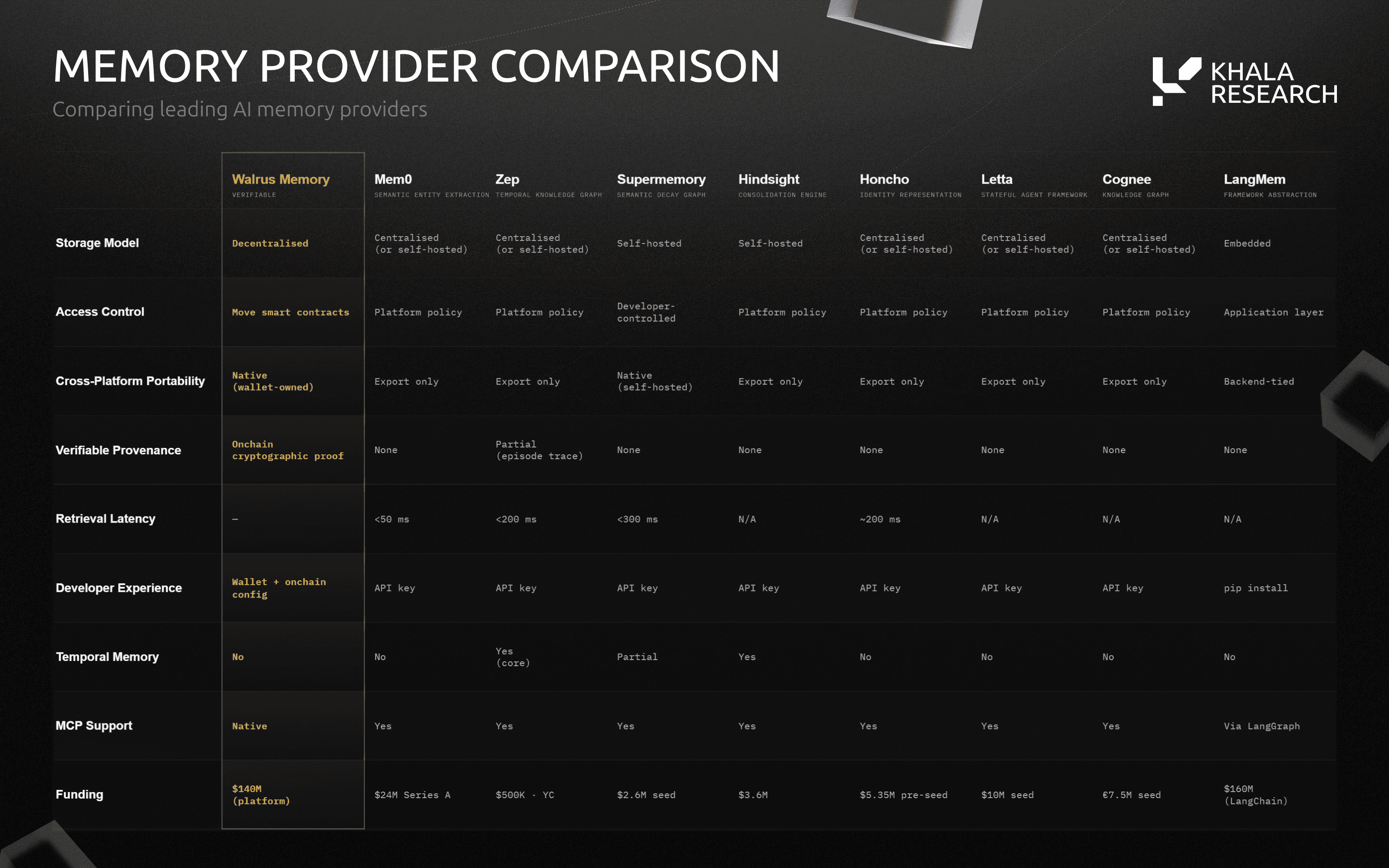
Mem0: Drop-in semantic search memory. $24M Series A from Y Combinator, Peak XV, and Basis Set. 59.5k GitHub stars. Production case study with TrendMicro on Amazon Bedrock and Neptune. Mem0 claims retrieval in under 50ms. A developer adds Mem0 with one line of code and an API key, and the agent gets semantic search over its interaction history. Mem0 is a managed service: the infrastructure is abstracted away.
Zep: Temporal fact management with validity windows. $500K pre-seed from Y Combinator. 28k GitHub stars. Zep built and open-sourced Graphiti in 2025, a temporal knowledge graph library that tracks how facts change over time. The Zep platform is the managed API and service built on top of Graphiti. Facts auto-invalidate when outdated: a procurement agent that learned a vendor's pricing in January does not act on that fact in June if the pricing has expired.
Letta: Self-improving memory blocks from UC Berkeley. $10M seed, led by Felicis. 23.5k GitHub stars. Letta gives agents self-improving memory: the agent can edit, consolidate, and delete its own memory records rather than appending endlessly. The architecture is grounded in research on memory management for autonomous agents.
Hindsight: Benchmark-leading retrieval accuracy. $3.6M seed, led by True Ventures. 17.5k GitHub stars. Hindsight ranked first on the BEAM benchmark for million-token conversations. Its MCP server was reported as most-deployed in enterprise environments per a Q1 2026 dope.security scan of ~10,000 devices.
Supermemory: Self-hosted by design. $2.6M seed funding led by Susa Ventures and Browder Capital. 27.5k GitHub stars. A team running Supermemory on its own infrastructure controls data locality, encryption, and access policies without depending on a vendor's cloud. It benchmarks well on LongMemEval and LoCoMo. The architecture is designed for self-hosting from the start, not adapted from a managed service.
Cognee: Knowledge graph memory. €7.5M seed, led by Pebblebed. 22.5k GitHub stars. Cognee built its architecture around knowledge graphs rather than vector databases. Where vector-based memory retrieves by semantic similarity, knowledge graph memory maps relationships between entities: which customers are connected to which contracts, which contracts reference which regulations. For use cases where structured relationships matter more than text similarity.
Honcho: Reasoning-first memory for multi-agent systems. $5.35M pre-seed, led by Variant. 5.5k GitHub stars. Honcho models relationships between agents and users. Instead of storing facts in isolation, it tracks the social context in which facts were learned: who said what to whom, and what that implies for future interactions. For multi-agent systems where agents need to reason about each other's behaviour.
LangMem: Memory for LangChain developers. $160M in LangChain parent-company funding, not specific to LangMem. 1.5k GitHub stars. LangMem plugs into the LangChain orchestration stack, using the same pipeline as the agent's tools and prompts. It is storage-agnostic and requires LangGraph.
These architectures are centralized: they rely on platform-managed trust rather than independently verifiable provenance, programmable access control, or portable ownership
Memory is also becoming a default feature of existing platforms. Weaviate added Engram to its vector database, TiDB launched Agent State Stack for SQL-backed agent memory and Microsoft Foundry added multimodal memory. Weaviate is an infrastructure incumbent bolting memory onto an existing vector database. TiDB captures the portability narrative without decentralisation, offering SQL-backed agent state that can move across model providers but remains centralised. Microsoft Foundry bundles memory with Azure's enterprise footprint. Each validates that memory matters. None addresses verifiability, programmable access control, or cross-platform portability.
The comparison matrix shows where Walrus Memory has no competitor and where it lags. Walrus has decentralised storage, verifiable provenance, and smart contract access control. The self-hosted path is the most complex to configure. The managed path delivers verifiable provenance in minutes with no blockchain expertise required.
Self-hosting Mem0 is the closest alternative. A team running Mem0 on its own infrastructure controls encryption, access policies, and data locality. Most of Walrus's architectural advantages disappear. The exception is proof. A self-hosted Mem0 instance cannot show a regulator that the context an agent acted on was exactly what was stored. Onchain registration is a way to get that proof. No feature addition to a centralised system bridges the gap.
Zep comes closest on access control. Zep enforces rules at the platform level. Walrus enforces them at the data layer through Move smart contracts. The difference is who can change the rules. The provider can alter a platform policy with 30 days' notice. A smart contract stands until its conditions are met.
The same principle applies to storage. Filecoin sells commodity storage at variable prices with no access control. Arweave sells permanent storage that cannot change once written. Neither offers programmable expiration or conditional access. Walrus Memory pairs storage with smart contract access control, Seal encryption, and an SDK built for agent memory.
The incumbents are not standing still. Mem0 has $24M and 59k GitHub stars. Weaviate, TiDB, and Microsoft optimise for speed over verifiability, and can add memory features faster than Walrus grows. These competitors have not announced decentralised storage, onchain provenance or signalled plans to rebuild on a blockchain. The gap is open and, for now, it is Walrus's to lose.
6. CATALYSTS & RISK FACTORS
Catalysts
Regulatory pressure on AI data handling. The EU AI Act requires high-risk AI systems to maintain automatic event logging and traceability under Article 12, and deployers must retain those logs for at least six months under Article 26. Provisions are phasing in through 2025 and 2026. Agent memory with onchain provenance and tamper-evident verification positions as compliance infrastructure for systems that must prove what data an agent accessed and when. The regulation creates a procurement requirement for exactly the properties Walrus Memory offers. Regulators have not named decentralised memory as a compliance solution, but the requirement for auditable AI data handling is enforceable law, not guidance. Signal: regulatory guidance or enforcement actions specifically addressing AI agent data retention or auditability.
MCP commoditising the connection layer. If Model Context Protocol becomes the standard interface between AI tools and external services, the question shifts from "can I connect memory to my agent?" to "what makes my memory different?" Walrus Memory's verifiability, programmable access control, and portability become the differentiator once connection is solved. Signal: mainstream MCP support across Claude, GPT, Gemini, and open-source agent frameworks without custom integration work.
Enterprise validation through a named pilot. The thesis rests on the existence of a buyer segment that values verifiability and programmable access control over speed and convenience. No buyer in that segment has publicly materialised. A single named pilot for an enterprise such as a financial services firm, healthcare provider, or legal technology company would shift the product from technical curiosity to validated infrastructure. Signal: a press release, case study, or procurement document naming Walrus Memory as infrastructure for audit-compliant agent workloads.
Memory portability becoming a procurement requirement. Enterprises deploying agents across OpenAI, Anthropic, and Google models simultaneously are accumulating context that compounds inside one platform and cannot transfer. That is the switching cost built into every agent session. If procurement frameworks and vendor assessment templates begin explicitly requesting cross-model memory portability, the market starts treating memory as data the enterprise owns, not data the platform holds. Walrus Memory's wallet-native ownership model is the architecture where memory is fundamentally portable because it was never locked to a provider in the first place. Signal: published enterprise AI procurement frameworks or RFP templates that name memory portability or cross-model context continuity as a requirement.
Risk Factors
Mem0 captures the enterprise market. Mem0 has $24M in Series A funding, 59k GitHub stars and under 50ms retrieval. It is the default choice for developers who want memory without infrastructure overhead. Centralised convenience wins early markets more often than structural differentiation does. If Mem0 adds enterprise compliance features before Walrus demonstrates traction, the window starts to close. Signal: Mem0 security or compliance feature announcements.
Speed gap limits addressable market. Walrus Memory retrieval is slower than centralised alternatives. The Supermemory latency budget analysis (May 2026) defines concrete thresholds by use case: voice AI requires sub-100ms retrieval, conversational chat 200ms, enterprise copilots 400ms. Walrus exceeds every real-time category. This excludes live customer support, high-frequency agent coordination, and any workflow where fast retrieval is a requirement. If those use cases represent the majority of agent memory demand, Walrus Memory competes for a fraction of the addressable market. Even within the enterprise segment, buyers who value auditability may still require response times that Walrus cannot deliver. Signal: independent benchmark data showing the latency gap widening or narrowing.
AI labs absorb memory into native platforms. Anthropic's Memory Stores API already exists in managed-agents beta with SHA-256 content hashing and append-only versioning. OpenAI has consumer memory and could extend it to API. If either lab adds cross-model portability, timestamped audit logs, or third-party verification, the rationale for independent memory infrastructure weakens. Cross-model portability is not in their commercial interest, but enterprise demand could force a defensive response. Signal: OpenAI or Anthropic API announcements adding memory features.
Sui outages could undermine confidence. Sui suffered three mainnet outages in May 2026 from upgrade bugs in the v1.72 release. The outages halted Walrus mainnet write operations. Sui's recent downtime reflects the challenges of early-stage network operations often seen in maturing blockchains, but most users don't care about a justification for downtime. They care that the service went down, not why. As more users and agents depend on Sui and Walrus Memory for storage, each halt carries a higher cost. Stabilising the network is critical to adoption. Without it, growth stalls regardless of product merit. Signal: Sui incident reports and uptime metrics.
Token economics may not support the thesis. The platform raised $140M in funding. With the token unlock schedule continuing and new supply entering circulation, sell pressure from node operators and distributions may outweigh organic demand from storage fees unless Memory adoption and other forthcoming features drive material usage. Signal: quarterly protocol revenue versus token unlock schedule.
7. SCENARIO TABLE
Scenario | Conditions | Watch For | |
|---|---|---|---|
Bear | No named enterprise pilot by Q2 2027. No third-party Walrus Memory integrations beyond first-party plugins. WAL protocol revenue remains below $100K annualised. Sui suffers another significant outage. | Walrus Memory remains a platform feature without standalone traction. The protocol-level advantages exist but find no buyer. Storage revenue does not materialise as a meaningful WAL demand driver. | Walrus Memory GitHub activity; Sui incident reports; onchain storage payment volume |
Base | 1-3 named enterprise pilots or partnerships. 3-5 third-party Walrus Memory integrations. WAL protocol revenue reaches $500K-$2M annualised. Sui maintains >99% uptime. | Walrus Memory establishes credibility as a viable option for regulated industries. Protocol revenue validates storage demand for agent workloads. The product captures a meaningful niche without displacing other providers for the majority. | Integration announcements; enterprise case studies; developer activity; onchain payment trends |
Bull | 5+ named enterprise deployments including at least one non-crypto enterprise. 10+ third-party Walrus Memory integrations. WAL protocol revenue exceeds $5M annualised. Sui maintains stable uptime. | Decentralised agent memory recognised as a category. Enterprise demand validates the thesis. Walrus Memory becomes a default consideration for procurement teams evaluating agent infrastructure with audit requirements. | Enterprise contract announcements; integration ecosystem growth; protocol fee accumulation |
8. CLOSING THESIS
Walrus built a storage network holding thousands of terabytes, published a peer-reviewed erasure coding scheme, and launched an SDK for AI agent memory. The architecture delivers four properties centralised competitors can't replicate easily: storage is decentralised, access control is smart-contract enforced, provenance is verifiable, and ownership is wallet-native. The architecture is sound but the market has not been validated.
The technical position is defensible. These are properties built into the protocol, not enforced by contract. For Mem0 or Zep to match Walrus on trust, they would need to replace their policy engines with smart contracts and add onchain hashing to every memory operation. The moat is narrow but it is real. The open question is demand. No significant enterprise has publicly adopted Walrus Memory. The agent memory segment is still forming.
Scale is the variable and adoption is the trigger. A single named enterprise pilot would shift the product from infrastructure proposal to validated deployment. The EU AI Act creates procurement pressure for auditable data handling. MCP commoditises the connection layer, shifting the question from integration to differentiation. Enterprises are accumulating context across model providers that cannot transfer, building memory debt until portability becomes a requirement. None of these are guaranteed. Section 6 lists the events that would reverse the thesis.
No standard has emerged for agent memory. When one does, the architecture that already delivers cryptographic proof, programmable access control, and provider-independent ownership and portability will not need to compete on convenience. The guarantee can be added to a centralised architecture, but none of the providers have done so. It has to be built from the storage layer up. That is what Walrus is.
DISCLAIMER
This report was commissioned by the Walrus Foundation. Khala Research received compensation for its production. All analysis, conclusions, and risk assessments are independently formulated by Khala Research and have not been subject to editorial approval by the project team. This report does not constitute investment advice, a solicitation to buy or sell any asset, or a recommendation of any kind. Readers should conduct their own due diligence and consult legal and financial advisors before making any investment decisions.
