x402: UNLOCKING THE INTERNET'S MISSING PAYMENT LAYER
KEY TAKEAWAYS
The internet was built without a native way to move money. In the 1990s, Tim Berners-Lee reserved HTTP 402 ("Payment Required") as a placeholder for digital cash. It sat unused for thirty years. Instead, the web defaulted to advertising, walled gardens, and credit card forms.
That placeholder is now live.
x402, developed by Coinbase and Cloudflare, operationalizes HTTP 402 to enable autonomous, stablecoin-based payments embedded directly in the HTTP handshake. The implications:
1. Protocol-level shift: x402 makes payment as native to the web as loading an image. No accounts, no API keys, no subscriptions. Payment IS authentication.
2. Institutional endorsement. Tier-1 institutions have committed capital or integration:
Coinbase (creator, top facilitator)
Cloudflare (co-founded x402 Foundation)
Google (A2A / Agent Payments Protocol)
Visa (Trusted Agent Protocol)
Stripe (live on Base, Feb 2026)
Circle (Arc in development)
3. Scale emerging, but context matters: x402 has processed ~165M transactions and ~$46.5M in cumulative volume. Although Visa's Head of Crypto noted that roughly 95% of 2025 x402 volume was tied to memecoins. Real enterprise utility is nascent. This is early infrastructure and priced accordingly. For context, x402's entire 10-month transaction volume is less than one Visa day.
4. The agentic stack is in place: x402 handles payments. ERC-8004 handles agent identity and reputation. ERC-8183 adds the commercial relationship: verifiable terms, escrowed funds, delivery attestation, and deterministic settlement. ERC-8126 adds agent security scoring to the identity layer: four verification types that aggregate into a 0-100 risk score, giving any counterparty a quantified trust signal before transacting.
5. AI agents are already transacting at scale: Visa built its Trusted Agent Protocol with x402 interoperability after observing a 4,700% surge in AI-driven retail traffic. A16z projects $30 trillion in autonomous agent transactions by 2030. Agents need microtransactions, 24/7 global rails, and sub-cent fees. Legacy rails structurally cannot serve these needs but x402 was built for it.
6. No native protocol token is a feature: Protocol neutrality accelerates adoption by eliminating rent-seeking friction. Value accrues to facilitators, settlement chains, agent frameworks, and identity layers.
For Capital Allocators
Every year, Visa and Stripe process $14T and $1.9T respectively. The aggregate x402 ecosystem market cap for tokens with genuine protocol connection is under $700M, less than 0.05% of the terminal addressable market for machine payment rails.
x402 is an open protocol. The ecosystem building around it, from agent frameworks to facilitators to identity layers, represents one of the largest emerging infrastructure opportunities in crypto AI. The investable universe spans around x402, rather than the protocol itself.
![[share]](https://framerusercontent.com/images/OafWy8nA2t8TO0HwP5fKj4utpU.png)
EXECUTIVE SUMMARY
Stripe's $1.9T in annual volume is processed through the same 30-year-old plumbing: account creation, Know Your Client (KYC), card networks, 2.9% plus $0.30 per transaction. None of it works for machines. Autonomous agents need to buy compute cycles, data feeds, and API access at sub-cent price points, continuously, without filling out forms or absorbing a $0.30 minimum on a $0.001 API call.
x402 is the first credible attempt to solve this. Built by Coinbase and launched in May 2025, the protocol embeds payment directly into HTTP by activating the long-dormant 402 status code. An agent requests a resource. The server responds with a price, token, and address. The agent signs a payment proof. A facilitator verifies and settles onchain. The resource is delivered with no accounts, subscriptions or API keys. Settlement in two seconds. Cost on Base: ~$0.0001.
x402 processed ~165M transactions in its first ten months, with ~$46.5M in cumulative volume. Cloudflare co-founded the x402 Foundation (Sep 2025). Google integrated it into the Agent-to-Agent protocol. Then in February 2026, Stripe launched x402-based USDC payments on Base through its Payment Intents API, while simultaneously incubating Tempo. Tempo is a payments-first layer 1 blockchain co-built with Paradigm, which raised $500M at a $5B valuation with OpenAI, Visa, Shopify, and Anthropic as design partners. Visa, citing Adobe data showing a 4,700% surge in AI-driven retail traffic, built x402 interoperability directly into its Trusted Agent Protocol. Incumbent payment networks are already designing for an agentic future.
"A torrent of agentic commerce is coming in the next few years."
John Collison, Co-Founder, Stripe
This report maps the x402 ecosystem for capital allocators: the protocol mechanics, the identity layer, the competitive landscape, the investable token universe, and the infrastructure being built for autonomous agent commerce.
![[share]](https://framerusercontent.com/images/M1MNTv66342eJrcCTB4bqHybs.png)
1. THE MISSING PAYMENT LAYER
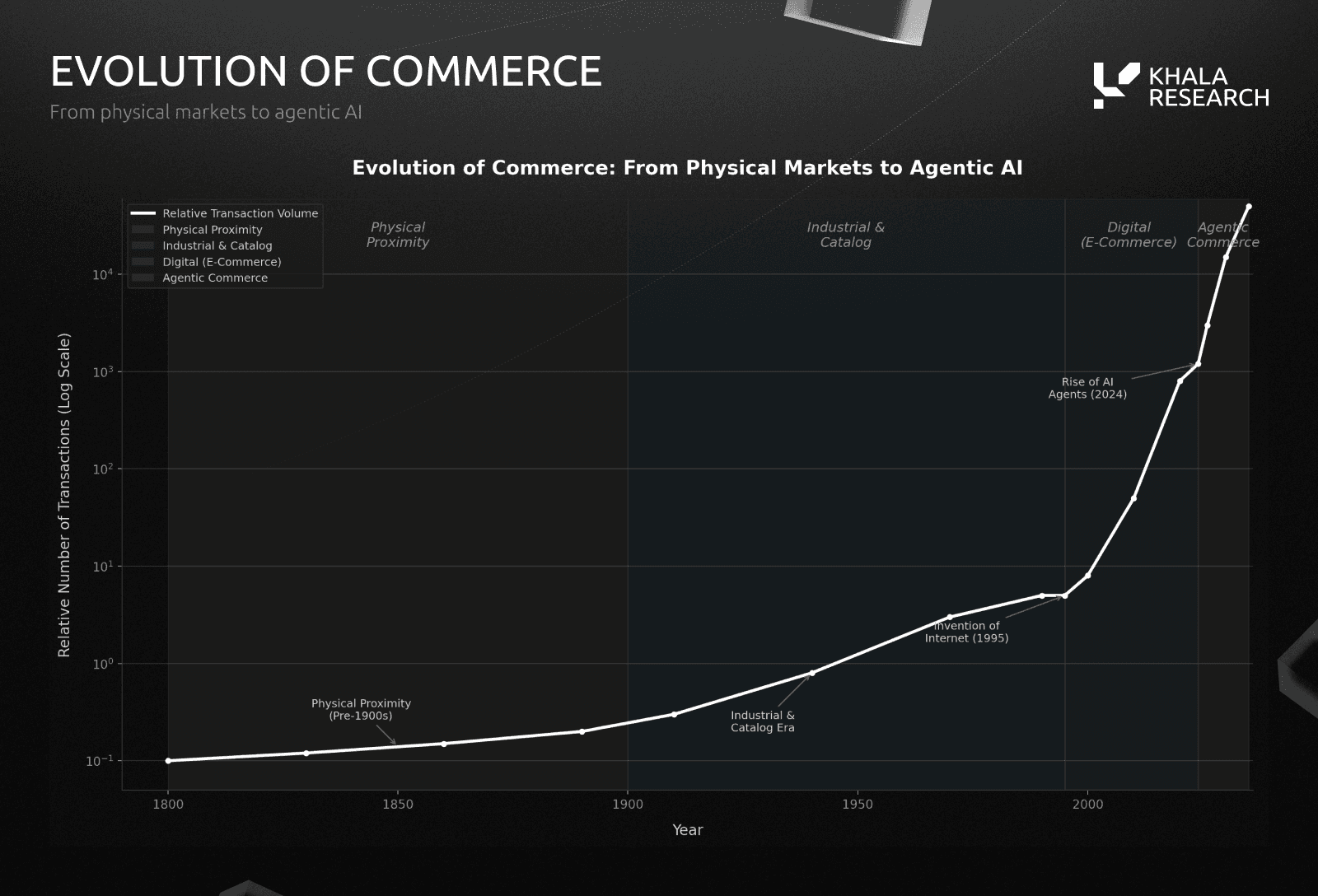
The history of commerce is a story of compounding transaction velocity. From the physical hand-offs of the 19th century to the global clicks of the 21st, each era has increased transaction volume by orders of magnitude.
However, the move toward Agentic Commerce requires a fundamental shift: a transition from human-validated payments to a machine-native financial layer designed for the speed of AI.
Physical Proximity (Pre-1900s): Localised trade and barter. Transactions required face-to-face interaction and manual exchange of physical goods
Industrial & Catalog (1900–1995): Mass production and "distance selling". The rise of department stores and credit cards decoupled shopping from physical cash
Digital / E-Commerce (1995–2024): The internet revolution. Commerce shifted to "anywhere, anytime" via websites, mobile apps, and social media
Agentic Commerce (2024–Present): A shift from searching to delegation. AI agents use reasoning and APIs to execute autonomous transactions for humans
Every generation of internet commerce has been defined by its payment rail. And every payment rail has been defined by the gap between what the internet needed and what the financial system could deliver.
In the mid-1990s, Tim Berners-Lee and his team at CERN reserved HTTP status code 402, "Payment Required," alongside 200 (OK) and 404 (Not Found). The intent was explicit: a native payment primitive for the web, as fundamental as a hyperlink. Any server could charge for any resource at the protocol level.
It never shipped, for two structural reasons:
No digital cash. Credit card networks had zero interest in processing cent-level transactions. Interchange fees of $0.30 plus 2.5% made any payment under $5 economically irrational.
No settlement layer. Without programmable, instant, low-cost settlement, micropayments were technically impossible at the infrastructure level.
Without protocol-native payments, the web defaulted to advertising. Google's advertising auction, Facebook's news feed, the entire clickbait industrial complex: all of it traces back to this single absent feature; the web was missing a payment layer.
E-commerce eventually arrived, but not as HTTP 402's creators envisioned. Instead, through proprietary checkout flows (PayPal, Stripe, Shopify): account creation, KYC, card entry, batch settlement, 2.9% plus $0.30. This works for a $50 purchase, but it cannot structurally work for a $0.001 API call.
For thirty years, HTTP 402 sat dormant; a reserved but undefined status code, waiting for infrastructure that did not yet exist. Now, two things have changed:
Stablecoins reached critical mass. USDC circulation hit $75.3 billion in Q4 2025, up from ~$500M in 2019. USDC facilitated $11.9 trillion in onchain transactions in 2025, a 247% year-over-year increase. These are programmable, dollar-denominated tokens that AI agents can hold and transact with natively. No bank account required.
Layer 2 fees collapsed. Base processes transactions for ~$0.0001. Solana averages ~$0.005. The fee floor that killed micropayments in the 1990s no longer exists. A $0.001 payment now costs ~$0.0001 to settle.
Erik Reppel, Head of Engineering at Coinbase's Developer Platform, built x402 to assemble these pieces into a working standard and since going live there has been over 165M payments, transferring ~$46.5M in value to one another.
2. HOW X402 WORKS
The x402 protocol adds two headers to standard HTTP requests:
X-PAYMENT-REQUIRED: The server uses this to specify what a resource costs - amount, token type, settlement network, and recipient wallet address, in machine-readable JSON.
X-PAYMENT: The client responds using this, which contains a signed payment proof that authorises the transfer before the server delivers the resource.
![[share]](https://framerusercontent.com/images/Mz6Fl2R7Mqt52RW56gPkjrQRI.png)
The Facilitator Layer
Facilitators are the critical intermediary: they handle verification and onchain settlement so API providers do not need to run blockchain infrastructure. Think of them as the payment processors of the x402 world.
Facilitator | All-Time Txns | All-Time | $ Mkt Share | Avg $/Txn | 30-Day |
|---|---|---|---|---|---|
Coinbase | 78,271,838 | $27.3M | 58.7% | ~$0.35 | $444K |
PayAI | 34,472,857 | $4.8M | 10.4% | ~$0.14 | $213K |
Dexter | 26,404,916 | $4.7M | 10.2% | ~$0.18 | $65K |
Virtuals Protocol | 1,672,040 | $3.6M | 7.8% | ~$2.16 | $2.3M |
Daydreams | 11,828,773 | $2.8M | 5.9% | ~$0.23 | $3.6K |
Total ecosystem all-time: ~165M transactions / ~$46.5M. Past 30 days: ~3.6M transactions / ~$3.5M. Source: x402scan.com (17 March 2026)
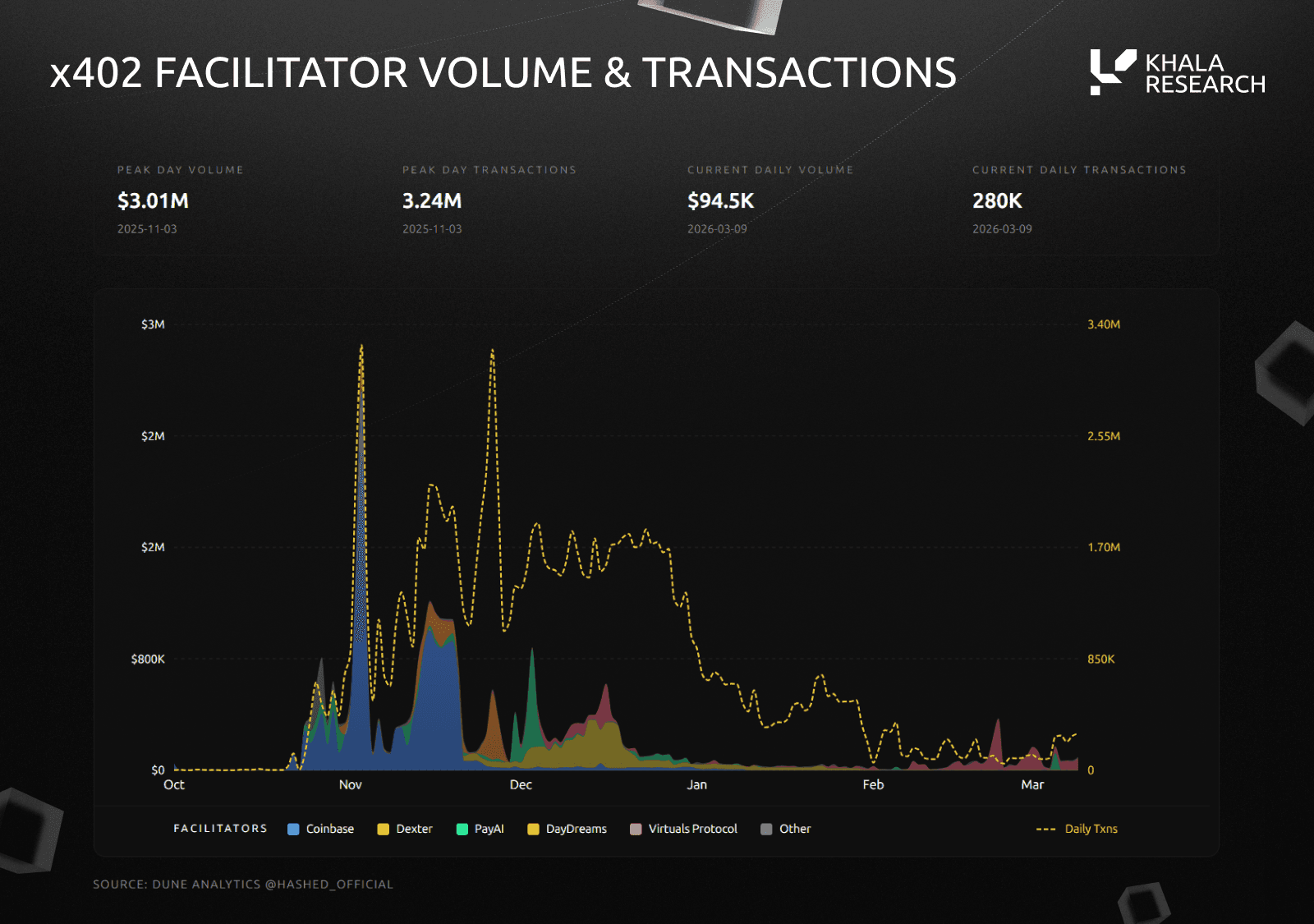
Coinbase's $ dominance is decisive: $27.3M of the $46.5M all-time total (58.7%) despite only ~48% of transaction count. Its $0.35 average reflects substantive API and data feed use cases running through CDP, not micropayment noise.
Dexter's 26M transactions and growing daily share look like competitive momentum, but transaction count leadership does not translate to dollar volume. At ~$0.05 per transaction in the past 30 days, 1,396 active sellers are generating $65K in volume: the seller base has grown, but the economics per transaction remain thin. Dexter's zero-fee model is compressing margins across the facilitator layer and building developer adoption, but not yet revenue.
Virtuals Protocol is the standout on 30-day $ volume: $2.3M of the $3.5M ecosystem total (65% share) at a ~$3.23 average: seven times the Coinbase average, across just 2 sellers. This reflects ACP endpoints charging higher per-call rates for substantive agent services, making Virtuals the highest-value $ flow in the current ecosystem.
x402 is chain-agnostic, live on Base, Solana, Polygon, Avalanche and others. It is also token-agnostic with any ERC-20 supported, although USDC represents 98.7% of settlement value. Open-source under MIT licence: no protocol fees, no native token, backwards-compatible via standard HTTP headers.
3. THE AGENTIC STACK
The internet has seen exponential growth in the past thirty years as digital replaced analogue, and online payment velocity dwarfed cash transactions. Agents are, however, relatively new. But plumbing these independent operators into the existing digital framework will catalyse activity at a rate faster than we’ve seen before.
x402 solves payments but not counterparty trust. Before transacting, a counterparty needs to verify who an agent is, whether it has executed reliably, and whether its claimed capabilities are credible.
Where traditional finance asks KYC of human counterparties, agentic commerce requires KYA: Know Your Agent. ERC-8004 handles identity and reputation; ERC-8126 adds security scoring.
ERC-8004: Agent Identity and Reputation
Identity Registry. ERC-721 NFTs function as agent passports. Each agent receives a portable, onchain identity linked to off-chain metadata describing its capabilities, endpoints, and provenance
Reputation Registry. Standardised feedback and ratings, portable across networks via cryptographic proofs. An agent builds a verifiable track record across every protocol and platform it operates on
Validation Registry. Cryptographic proof of execution through TEEs, zkML, or staking. Verifiable onchain without trusting any central intermediary
Transferability caveat. ERC-721 agent passports are transferable, meaning accumulated reputation can be transferred alongside the identity. Davide Crapis, Head of AI at the Ethereum Foundation and ERC-8004 co-author, addressed this on the Unchained podcast, noting that onchain visibility of transfers and reputational consequences act as the primary deterrents. The standard has no mechanism to restrict reputation inheritance
ERC-8183: Agentic Commerce
x402 and ERC-8004 address payment and identity. Neither addresses the commercial relationship: terms of work, escrow of funds, delivery verification, and deterministic settlement. ERC-8183 fills this gap. Co-developed by Virtuals Protocol and the Ethereum Foundation's dAI team and published March 10, 2026, it defines a single commerce primitive: the Job.
Client. Posts requirements and funds escrow. If neither party acts before the deadline, funds revert automatically
Provider. Executes the Job and submits a verifiable deliverable onchain
Evaluator. Attests to completion, triggering payment release or refund. Defined only as an onchain address: an LLM agent, a ZK verifier contract, or a multi-sig. The same interface handles a $0.10 image generation call and a $100,000 capital management engagement
Every completed Job produces a reputation signal that feeds back into ERC-8004: a verifiable onchain record of what was agreed, who delivered, and how it was evaluated. Custom logic attaches via Hooks: optional smart contracts that execute around state transitions without modifying the core, covering use cases from bidding and fund transfers to reputation-gated access and ZKP-based delivery.
ERC-8126: Agent Verification
Verification. Four types: onchain contract, staking contract, web endpoint, and wallet history
Proof generation. Each verification type generates a Zero-Knowledge Proof via off-chain providers, keeping detailed results private to the agent's wallet holder
Risk score. Results aggregate into a 0-100 score. Any third party can implement compliant verification services
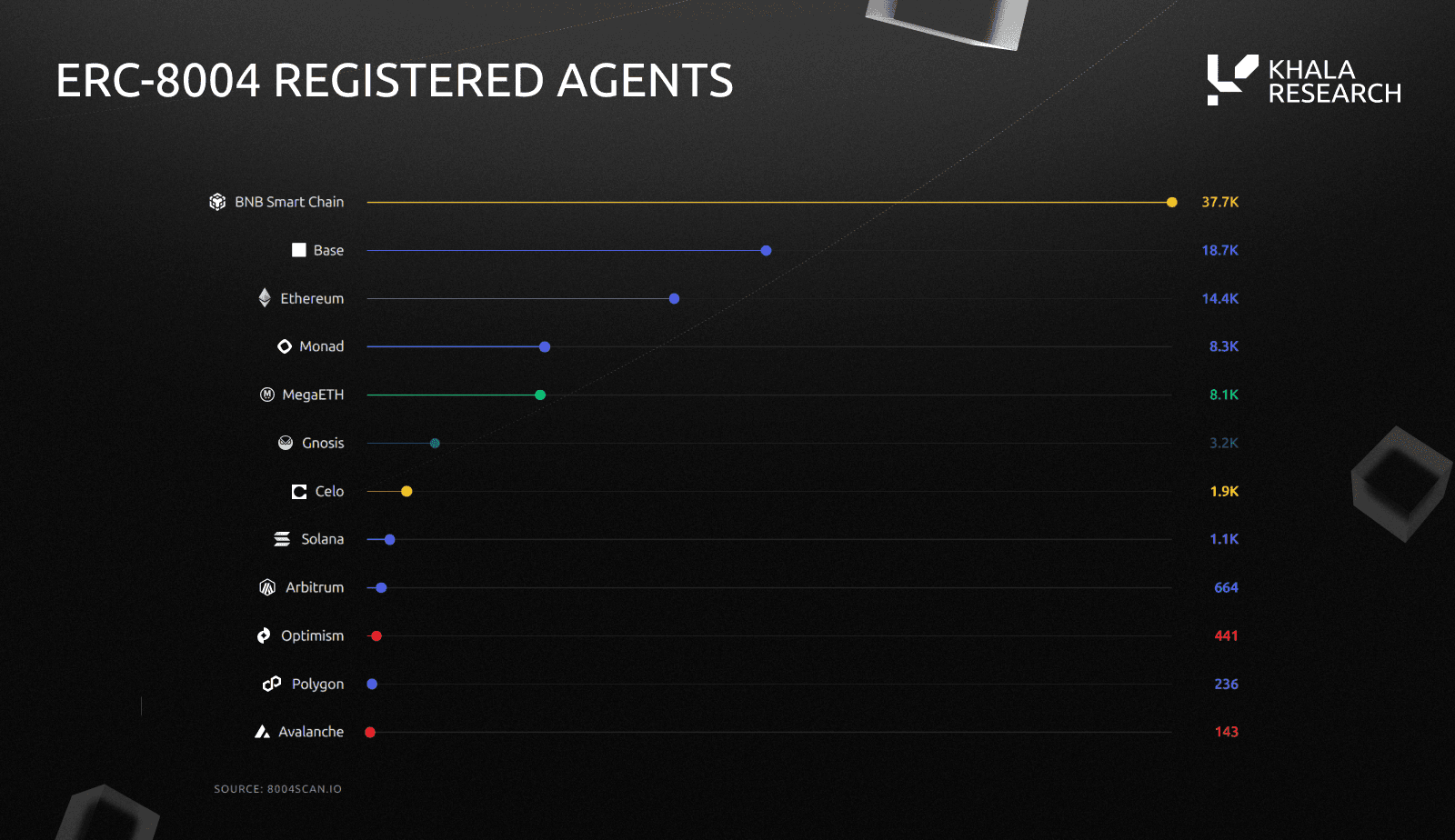
There have been over 70,000 agents registered on Ethereum, Base and BNB alone (March 16, 2026), but the same standard has been used to register agents on many other chains. 8004Scan provides a useful tool to identify registration by blockchain.
x402 provides the means to pay while ERC-8004 provides insight into who the agent is and whether you, or your agent, should trust them.
Together, they form the infrastructure stack for autonomous commerce. An agent can arrive at any x402-enabled endpoint, pay for a resource, and simultaneously prove its identity and track record - all within a single HTTP handshake. All of this happens without a human intermediary or account creation.
This is the point that separates x402 from prior micropayment attempts. Web2 payment infrastructure has no equivalent. Stripe can process a card payment. It cannot provide a cryptographically verifiable, portable, onchain reputation record for a non-human agent. OAuth 2.0 handles delegated authorisation. It was not designed for agents that operate without persistent human sessions, across thousands of endpoints simultaneously.
4. THE X402 LANDSCAPE
The x402 ecosystem has grown from a Coinbase prototype to a multi-chain, multi-stakeholder infrastructure layer in under 12 months. The CoinGecko x402 ecosystem category carries approximately $6.7B in aggregate market capitalisation, though this figure is materially inflated by tokens categorised as x402 ecosystem despite having primary value drivers elsewhere. Tokens with genuine protocol connection, such as those covered in Sections 5 & 6, represent under $700M in aggregate.
Who Is Building
There are several institutions that have committed capital or production integrations representing a cross-section of crypto-native infrastructure, Web2 payment giants, enterprise technology, and traditional finance:
Coinbase: Created x402, operates the CDP Facilitator, runs Base as the primary settlement chain, launched Agentic Wallets, and co-founded the x402 Foundation. Every x402 transaction touching Base or CDP generates revenue for Coinbase.
Cloudflare: Co-founded the x402 Foundation for open governance. Built the Agents SDK and MCP server support. Launched a private beta of pay-per-crawl, charging AI crawlers per page via a deferred x402 payment scheme. General availability would make every AI web crawl an x402 transaction.
Google: Integrated x402 into the Agent-to-Agent (A2A) protocol via the Agent Payments Protocol (AP2). Proof-of-concept with Lowe's Innovation Lab demonstrated an agent diagnosing a DIY project, building a cart, and checking out via USDC from a single prompt.
Stripe: Launched x402-based USDC payments on Base in February 2026 via the PaymentIntents API. Simultaneously incubating Tempo, a payments-first layer 1 at $5B valuation, with Paradigm.
Visa: Built the Trusted Agent Protocol with x402 interoperability after observing a 4,700% surge in AI-driven retail traffic. Predicts 20% of 2026 x402 volume will be tied to real-world use cases, up from near zero in 2025.
Circle: Issuer of USDC (98.7% of x402 settlement value) and a founding launch partner. Currently building Arc, a payments-optimised settlement network, that uses x402. A recent partnership with OpenMind targets the first machine-to-machine payment standard for physical robots.
PayPal Ventures. Led the $18M Series A in Kite AI alongside General Catalyst - the most direct TradFi venture bet on the x402 stack.
One notable absence: Tether, the largest stablecoin issuer by market cap ($183 billion; 62% market share), has no live x402 integration. Its Wallet Development Kit includes x402 as a native module and its February 2026 investment in LayerZero signals intent and is worth monitoring.
Pantera Capital published institutional research titled 'HTTP 402's Modern Makeover' and is actively sourcing x402 deals. a16z's 2025 State of Crypto report cited x402 specifically, anticipating $30 trillion in autonomous agent transactions by 2030. Galaxy Research published a dedicated x402 analysis in January 2026, estimating agentic commerce could represent $3-5 trillion in B2C revenue by 2030 and identifying x402 as core backend infrastructure for the transition.
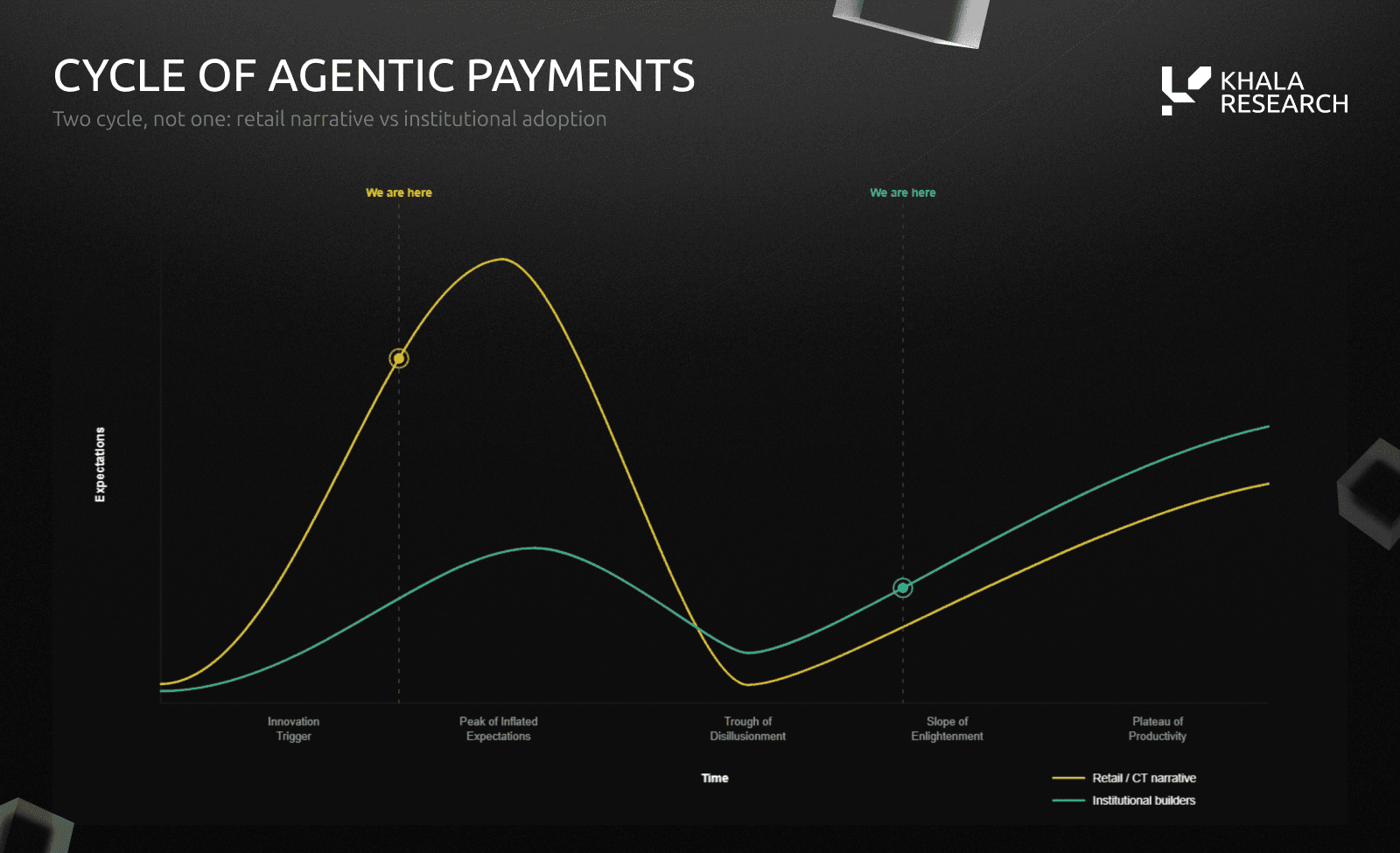
Visa's Cuy Sheffield delivered a very important data point: roughly 95% of x402 volume in 2025 was tied to memecoins. The institutional endorsements are genuine, but real revenue is not yet meaningful. The window to build a position before enterprise adoption converts predictions into revenue is open now.
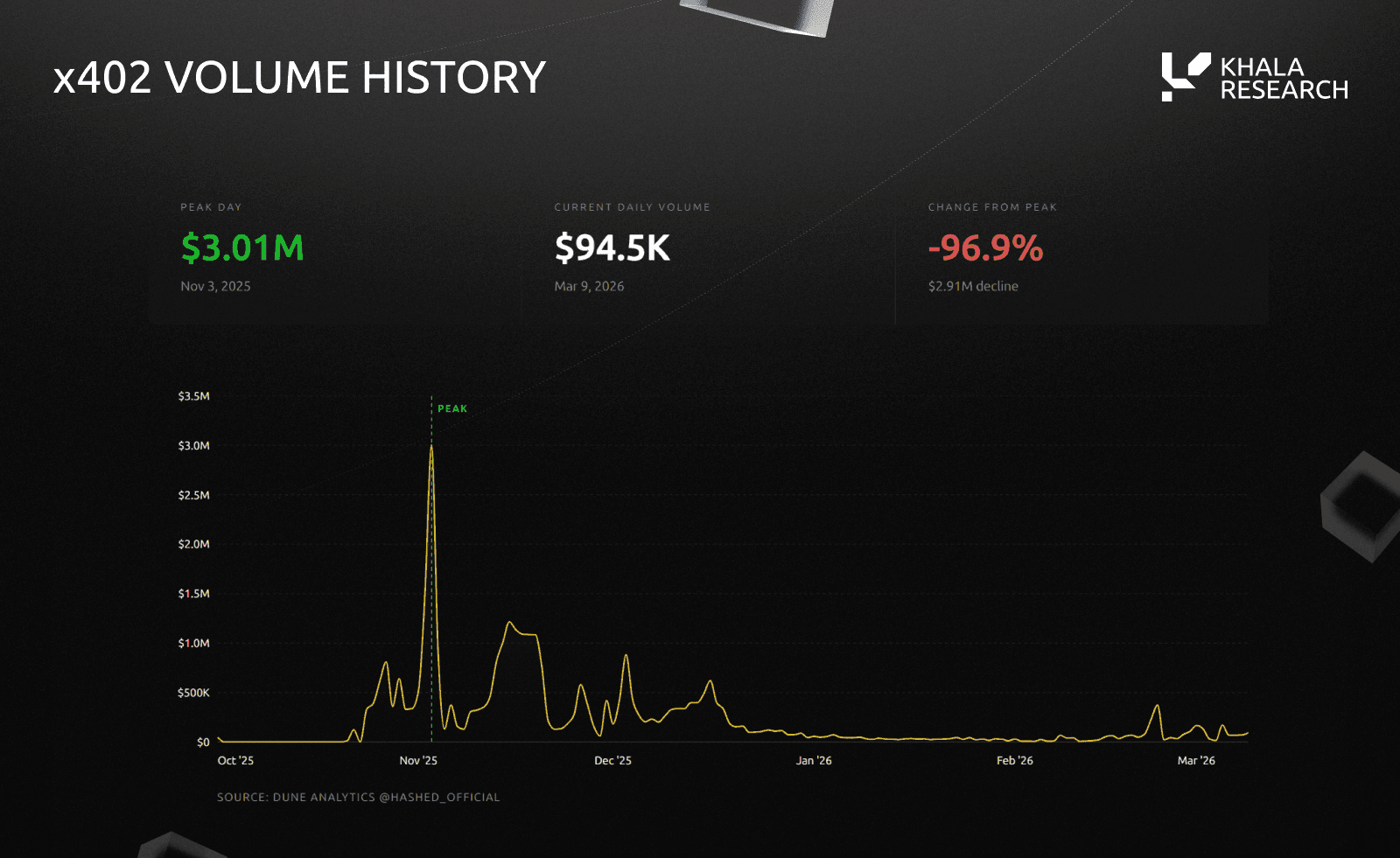
Intellectual honesty demands a look at the volume chart. Peak weekly volume of $5.3M in November 2025 has declined 96% to under $220K in February 2026. This is the result of a post-launch correction from a meme-driven spike, not protocol failure. It is almost identical in shape to early Stripe or early USDC adoption curves. The key question is whether the recent integrations, such as Stripe, signify true enterprise adoption or merely extended stagnation. While these are the first positive indicators, they do not yet confirm adoption.
One signal worth watching: Galaxy Research data shows the share of gamed or wash-traded x402 transactions dropped below 50% in early December 2025 and has continued falling, suggesting genuine use cases are beginning to displace speculative activity.
5. ECOSYSTEM COVERAGE
The x402 protocol is open-source with no native token, so every dollar of value it creates flows to the operators and applications built around it. The graphic below maps the six layers of the stack and the frame for evaluating every project in this section.
![[share]](https://framerusercontent.com/images/eu0BpUZWy3E2cgF6CtR7NouLmc.png)
The most durable value accrual sits at the base. Settlement chains earn sequencer and validator fees on every transaction. Stablecoin issuers capture reserve yield on circulating supply, a function of total ecosystem volume. The identity layer earns minting and attestation fees that compound as high-value autonomous transactions require verifiable counterparty trust, with network effects accruing to whichever registry accumulates the most onchain reputation data.
The middle layers are where competition is fiercest. Facilitator fees are commoditising quickly as zero-fee models compress margins, and durability requires building application-layer switching costs above the facilitation function itself. Agent frameworks and commerce operating systems capture router and transaction fees where developer adoption compounds; the moat is developer experience and ecosystem integrations, which deepen with every new tool and partnership added.
Discovery and commerce layers are early stage and represent the largest unpriced opportunity in the stack, but neither has demonstrated revenue at scale. The physical economy layer remains pre-revenue, with its moat resting on hardware-software integration rather than protocol economics.
5.1 COINBASE ($COIN)
Protocol author, dominant facilitator, primary settlement chain - the single entity with a simultaneous stake in every layer of the x402 stack.
AT A GLANCE:
Category: Regulated equity; multi-layer x402 exposure (protocol, facilitator, settlement chain, USDC yield)
x402 Position: 58.7% of all-time ecosystem $ volume; Base primary settlement chain; $27M+ x402 volume
CDP Facilitator (March 2026): ~25% daily average; Coinbase retains cumulative $ leadership
CDP Pricing: 1,000 free tx/month; $0.001/tx thereafter; Agentic Wallets launched
Key Signal: x402 not yet a disclosed earnings line item; zero machine commerce revenue in any analyst consensus model
Watch For: First x402 revenue disclosure in Coinbase earnings; competitor facilitator dominance stabilising or reversing
Strategic Positioning
Coinbase occupies multiple layers of the x402 stack simultaneously, a position no other entity in the ecosystem holds. It operates the CDP Facilitator, which despite Dexter's rise to 35% daily share, retains the largest cumulative facilitator position by onchain dollar volume. It sponsors Base as the primary x402 settlement chain, earning sequencer revenue on every transaction that settles there. It participates in USDC economics through its reserve yield arrangement with Circle.
This architecture means Coinbase captures value whether the x402 ecosystem concentrates or fragments. If CDP retains facilitator dominance, it earns direct per-transaction fees. If facilitators commoditise, which is happening with Dexter now at ~35% daily share, Coinbase still captures Base sequencer revenue and USDC float. Protocol neutrality enforced by the x402 Foundation accelerates enterprise adoption, expanding total settlement volume flowing through Base.
Context
x402 was designed to solve a developer platform pain point Coinbase observed building CDP. API providers were charging agents through legacy rails (API keys, subscriptions, batch billing) that added friction, cost, and operational overhead. Erik Reppel, Head of Engineering at Coinbase's Developer Platform, built x402 to create an alternative: pay at the protocol layer, verify onchain, eliminate the billing stack entirely.
The open-source MIT licence and the co-founding of the x402 Foundation with Cloudflare were deliberate moves to prevent x402 from being perceived as a Coinbase proprietary standard. The governance structure ensures Stripe, Google, and Visa can participate without ceding control to Coinbase. This is the same playbook Ethereum used to become the default smart contract platform: open the standard, build the infrastructure, capture the network.
Agentic Wallets extend the x402 play into the identity layer. These are programmable wallets designed specifically for non-human agents, with programmable spending limits, delegated authority structures, and native x402 integration. Developers building on CDP can provision an agentic wallet, attach x402 payment logic, and have a transaction-capable agent running in under an hour.
Mechanism Design
Coinbase's x402-related revenue accrues across four channels, each with a different scale and durability profile:
Base sequencer fees. Every x402 transaction settling on Base generates a sequencer fee for Coinbase. With 78M+ cumulative x402 transactions onchain and $27M+ CDP facilitator volume, this is the most established revenue channel.
CDP Facilitator fees. Direct per-transaction revenue at $0.001/txn after the 1,000 free monthly tier. As enterprise usage scales above the free threshold, CDP becomes a meaningful revenue line.
USDC yield participation. USDC represents 98.7% of all x402 transaction value. Coinbase's arrangement with Circle over reserve yield on USDC holdings means that every dollar of USDC locked in x402 payment flows contributes indirectly to Coinbase's revenue.
Agentic Wallets. A new product line with native x402 integration. The agent wallet provisioning model is early-stage but likely to become a significant CDP revenue driver as autonomous agent deployment accelerates.
Competitive Landscape
Competitor | Relationship to Coinbase | x402 Threat Level |
|---|---|---|
Solana | Crossed 50% of weekly x402 transaction count Feb 2026 | MEDIUM - volume growing but $ value still Base-dominant |
Stripe / Tempo | Stripe live on Base (additive) Tempo L1 targets enterprise settlement - potential Base competition at scale | LOW near-term; MEDIUM long-term if Tempo captures enterprise |
Dexter (facilitator) | Surpassed CDP in daily facilitator transaction share (~35% vs ~25%). Zero-fee model compresses margins | MEDIUM for facilitator revenue; LOW for sequencer/USDC |
PayAI / DayDreams (facilitators) | Competing facilitators taking share from CDP | LOW - facilitator commoditisation hurts all facilitators equally |
Risk Factors
Solana's rise to 50%+ of weekly x402 transaction count is a direct threat to Base's primacy as the default settlement chain. Permanent volume migration would reduce sequencer upside
Dexter's rise to ~35% daily facilitator share demonstrates that the CDP free-tier strategy has not prevented significant competition at the application layer
x402 is not yet disclosed as a material line item in Coinbase earnings. No analyst consensus model prices in machine commerce revenue
Coinbase's dual role as protocol author and dominant facilitator creates a governance tension. If CDP is perceived to have privileged access, institutional adopters may prefer neutral facilitators
Outlook
For traditional allocators seeking x402 exposure, $COIN is a clean entry point: regulated, Nasdaq-listed, and institutionally accessible. The x402 machine commerce flywheel is not priced into any consensus model. A single analyst note or earnings mention of x402-specific revenue could re-rate the story meaningfully. The multi-layer moat: protocol authorship, facilitator operations, settlement chain, and stablecoin economics is structurally durable even in a fragmented facilitator market.
5.2 TEMPO
Stripe, the world's largest private payments processor, goes live on x402 while incubating the purpose-built settlement layer for the machine economy, with the most credible enterprise design partner network ever assembled for a blockchain project.

AT A GLANCE:
Category: Payments-first layer 1 blockchain; incubated by Stripe and Paradigm
Stripe Today: x402 live on Base via PaymentIntents API (Feb 2026); $140B valuation; $1.9T annual volume
Tempo Raise: $500M at $5B valuation (Oct 2025); Greenoaks, Thrive Capital, Sequoia, Ribbit, SV Angel
Design Partners: OpenAI, Anthropic, Visa, Mastercard, UBS, Deutsche Bank, Standard Chartered, Klarna, Revolut, Shopify, DoorDash, Nubank and others
Status: Mainnet targeted 2026; no token announced; uninvestable for token allocators today
Watch For: Mainnet launch date; Stripe x402 revenue disclosed in earnings
Strategic Positioning
Stripe's February 2026 x402 launch was a production deployment, by the company that processes $1.9 trillion in annual payment volume and controls 20-29% of global online payments. When Stripe commits to a payment standard, every SaaS company, API provider, and enterprise developer takes note.
Tempo is the longer-term bet. A purpose-built settlement layer for enterprise-grade stablecoin flows, onchain payroll, tokenised deposits, and agentic payments at the scale Stripe's customer base represents.
Context
Stripe's machine payments ambition requires infrastructure that general-purpose blockchains cannot provide at enterprise compliance standards. Base and Solana process x402 transactions efficiently, but neither was built with Mastercard, UBS, and Deutsche Bank as design partners, and neither natively handles the audit trail, regulatory reporting, and institutional custody requirements that tier-1 financial institutions demand.
Tempo is being built for this purpose. Co-incubated with Paradigm (Matt Huang leading, with Dankrad Feist joining from the Ethereum Foundation), it is a purpose-built payments layer 1, not an Ethereum rollup, designed from first principles for cross-border remittances, payroll processing, tokenised deposits, and agentic payments at enterprise scale. Klarna launched KlarnaUSD on Tempo's testnet in November 2025, making it the first bank to issue a stablecoin on the network, with mainnet launch targeted for 2026. The $500M Series A was led by Greenoaks and Thrive Capital, with Sequoia, Ribbit Capital, and SV Angel participating.
The Farcaster founding team - Dan Romero (COO) and Varun Srinivasan (CTO), plus the full Merkle Manufactory engineering team - joined Tempo after Neynar acquired Farcaster. Romero described stablecoins as "a generational opportunity." Tempo grew from 15 employees in September 2025 to 40-50 by November, with 17 open roles in early 2026.
The Stripe x402 Implementation
In February 2026, Stripe launched x402-based USDC payments on Base through its PaymentIntents API. Developers create a PaymentIntent, Stripe generates a deposit address, the agent sends USDC, and Stripe tracks settlement through its standard dashboard with existing tax, refund, and reporting tooling intact. Stripe also released an open-source CLI tool called 'purl' for developers to test machine payments in the terminal.
"Agents need microtransactions, 24/7 global rails, controls, HTTP-native, low latency, finality guarantees. The current financial system is tuned for humans."
Jeff Weinstein, Product Lead, Stripe
Competitive Landscape
Competitor | Type | Differentiation vs. Tempo |
|---|---|---|
Base (Coinbase) | General-purpose L2 | Larger ecosystem, established liquidity. Not designed for enterprise compliance requirements. |
Solana | High-throughput L1 | High TPS, low fees. Not enterprise-focused; no equivalent TradFi design partner network. |
Ethereum | General-purpose L1 | Dominant smart contract platform. High fees for micropayments; not payments-optimised. |
Stellar / Ripple | Payments-focused chains | Established TradFi relationships. Older architectures; less AI-native design. |
SWIFT | Traditional rails | Global standard for interbank settlement. Slow (days), expensive, not programmable. |
Risk Factors
Tempo has no token and remains uninvestable for crypto-native allocators as of March 2026. It intends for stablecoins to be used to pay gas.
Layer 1 blockchain competition is intense. Tempo must demonstrate that its enterprise-grade architecture justifies developer migration away from existing blockchains.
Enterprise design partner commitments from Mastercard, UBS, and Deutsche Bank are cooperation agreements, as opposed to revenue contracts. Commercial deployment timelines for institutional stablecoin settlement are a multi-month endeavour, or can sometimes take years.
Stripe's x402 implementation is early-stage. No material revenue contribution to Stripe's $1.9T annual volume has been disclosed.
Outlook
Tempo is currently uninvestable in the x402 ecosystem for the average allocator. The Stripe and Paradigm-backed stablecoin layer 1 has a number of live enterprise design partners across Visa, Mastercard, UBS, OpenAI, and Deutsche Bank. For current allocators, the Tempo mainnet launch in 2026 is the primary catalyst to watch, particularly around the applications that deploy. Stripe's x402 revenue becoming a disclosed metric in earnings will be a strong indicator of x402 adoption.
5.3 KITE AI ($KITE)
The purpose-built L1 where agents have verifiable identities, programmable governance, and native stablecoin payment rails. Backed by the venture arm of one of the world's largest payment processors.

AT A GLANCE:
Category: Agent-native L1 blockchain; purpose-built for verifiable identity, programmable governance, and machine-native stablecoin payments
Market Cap: ~$368M (~$2B FDV); double-backed by PayPal Ventures (Series A) and Coinbase Ventures (extension)
Live Today: Kite AIR operational; integrations into PayPal, Shopify, Google A2A, Anthropic MCP, OAuth 2.1
Architecture: BIP-32 three-layer agent identity; sub-100ms latency via state channels; ~$0.000001/tx
Risk: Developer adoption early-stage; ~$368M prices in PayPal potential, not current production scale
Watch For: First disclosed enterprise production deployment; mainnet throughput metrics
Strategic Positioning
Kite occupies a distinct position in the x402 ecosystem: it is a layer 1 blockchain built from first principles to treat AI agents as first-class economic actors. While general-purpose chains (Ethereum, Solana, Base) can process x402 transactions, Kite's architecture is optimised specifically for the three failure modes that prevent agents from operating autonomously at scale: credential management complexity, payment infrastructure barriers, and unverifiable trust between counterparties.
The Coinbase Ventures investment in October 2025 was the pivotal validation. The firm that wrote the x402 standard backed the first layer 1 to implement x402-compatible payment primitives at the chain level. The PayPal Ventures Series A signals that the $1.5T/year PayPal network sees autonomous agent commerce as a strategic extension. No other x402 ecosystem token has secured backing from both the protocol author's venture arm and a tier-1 traditional payment processor.
Context
Kite AI was formerly known as Zettablock, a real-time blockchain data infrastructure company serving Sui, Polygon, Chainlink, and EigenLayer. Kite is built directly on that foundation to serve a new breed of users: agents. Kite's five guarantees form the SPACE framework:
Stablecoin-native payments
Programmable constraints
Agent-first authentication
Compliance-ready audit trails
Economically viable micropayments
The three-layer agent identity architecture via BIP-32 hierarchical derivation is the most technically sophisticated identity system in the x402 ecosystem. User keys hold root authority. Agent keys hold delegated authority scoped by programmable governance rules. Session keys handle individual transactions with time-limited permissions. Kite AIR (Agent Identity Resolution) is live with integrations into PayPal and Shopify.
Competitive Landscape
Dimension | Kite AI | Base (Coinbase) | Solana |
|---|---|---|---|
Primary Purpose | Agent-native L1 | General EVM L2 | High-throughput L1 |
x402 Integration | Native at chain level | Via CDP facilitator | Via PayAI/Dexter facilitators |
Agent Identity | BIP-32 three-layer (native) | ERC-8004 (external standard) | ERC-8004 (external standard) |
Compliance Features | Built-in audit trails, OAuth 2.1 | Standard EVM tooling | Limited |
Latency | Sub-100ms (state channel latency) | ~2 seconds (full x402 flow including facilitator verification) | ~400ms |
Txn Cost | ~$0.000001 | ~$0.0001 | ~$0.005 |
TradFi Backing | PayPal Ventures, Coinbase Ventures | Coinbase (parent) | None direct |
Risk Factors
Layer 1 blockchain competition is the defining risk. Base, Solana, and general EVM chains already process x402 transactions efficiently. Kite must demonstrate that agent-specific optimisations justify developer migration from established chains with larger ecosystems and liquidity.
Primary value capture depends on agents choosing to operate specifically on Kite rather than general-purpose chains that already process x402 transactions efficiently. Developer adoption remains early stage.
~$368M market cap carries meaningful valuation risk relative to the current state of adoption. Less asymmetric upside than smaller pure-play positions.
PayPal's backing is a signal, not a guarantee of product-market fit. Institutional involvement at the venture stage does not translate automatically to production integration at PayPal's $1.5T/year transaction scale.
Outlook
The PayPal Ventures and Coinbase Ventures double-stamp is a credible institutional signal in the x402 token ecosystem. If PayPal deepens its integration to include PyUSD agentic payments and merchant-side x402 acceptance at scale, Kite becomes the bridge between TradFi payment rails and autonomous agent wallets, a positioning that other tokens will find difficult to replicate. The mainnet launch and first disclosed enterprise production deployment are the metrics to watch.
5.4 VIRTUALS PROTOCOL ($VIRTUAL)
The largest onchain AI agent economy: 21,000+ deployed agents, $480M+ in Agentic GDP.
AT A GLANCE:
Category: AI agent commerce OS via its ACP and aGDP
Market Cap: ~$518M (~$790M FDV)
Protocol Fees: $1.4M/month (Feb 2026); $69.6M cumulative
aGDP: $480M+ cumulative; 2026 target $3B+ annualised
x402 Role: Payment rail for ACP transaction layer; Virtuals is the commerce protocol built on top
Watch For: Mid-year aGDP run rate vs. $3B target; ACP autonomous jobs as share of total aGDP
Strategic Positioning
Virtuals Protocol is the most substantive x402 ecosystem project in terms of demonstrated onchain economic activity. It is an operating system for autonomous AI agent economies, not just an agent launchpad or token factory. They combine four integrated components into a flywheel that compounds with each new agent deployed. Virtuals co-authored ERC-8183 with the Ethereum Foundation's dAI team, published March 10, 2026. ACP's four-phase model predates the standard; ERC-8183 formalises it as the open reference implementation.
The distinction matters for allocators: $VIRTUAL's investment case does not rest on the x402 narrative alone. It rests on $1.4M in monthly protocol fees, 2.1M completed onchain jobs, and $3.7M in cumulative agent revenue, anchored by a clearly measurable output metric (Agentic GDP) that allows investors to track whether the thesis is advancing or stalling. This is the only position in the x402 ecosystem with a fundamental revenue anchor today.
Context
The Agent Commerce Protocol (ACP) is a four-phase onchain model: Request, Negotiation, Transaction, Evaluation. Governed by smart contract escrow and evaluator agents that verify outcomes before settlement. ACP is a commerce protocol, not a payment rail. It uses x402 as the payment rail at the transaction layer. ACP handles the commercial relationship (scope, pricing, delivery verification) while x402 handles the settlement (USDC transfer, onchain confirmation).
Component | Function | x402 Connection |
|---|---|---|
Agent Commerce Protocol (ACP) | Four-phase onchain commerce model with smart-contract escrow. Evaluator agents verify outcomes before payment releases. | x402 integration for pay-per-query data and cross-chain micropayments |
Butler | Human-to-agent interface on X and virtuals.io. Google Gemini 3 Pro backend. 30.8M conversations, 31,172 daily active users, and $473M+ aGDP flowing through this layer. Each request runs as an x402 transaction through ACP. | Every Butler request is an x402 transaction |
Unicorn Launchpad | Capital formation for tokenised AI agents. 10-year LP lock on graduation eliminates rug-pull risk structurally. | Agent capital formation and token infrastructure |
Virtuals Robotics | Physical extension of AI agents into robots via BitRobotNetwork Subnet 5. Q1 2026 expansion. | Physical agent economy payments via x402 |
The $1M monthly incentive program for revenue-generating agents creates a compounding flywheel: agents that earn more attract more capital, which deploys more agents, which generates more aGDP.
The aGDP Thesis
Agentic GDP (aGDP) is the total economic value created, exchanged, and reinvested by autonomous agents in the Virtuals ecosystem. Unlike AI-wrapper projects driven by speculation, $VIRTUAL's value is anchored to a measurable output. As of March 2026, aGDP stands at $480M+ across 2.1M completed jobs and 21,000+ deployed agents, with a 2026 target of $3B+ annualised.
One caveat for allocators: $473M of that $480M flows through Butler, the human-to-agent interface, rather than autonomous agent-to-agent commerce. The aGDP thesis ultimately depends on ACP autonomous jobs becoming the dominant flow. Reaching $3B requires roughly 5x growth from current trajectory. The mid-year run rate and the ACP-to-Butler ratio are the key metrics to watch.
Competitive Landscape
Competitor | Category | vs. Virtuals ACP |
|---|---|---|
OpenServ | Agent platform and commerce OS | Similar Build-Launch-Run model but smaller scale; ~$10-15M market cap vs ~$518M. Less onchain revenue data. |
DayDreams / DREAMS | Agent framework and facilitator | Framework play rather than full commerce OS. Complementary more than competing. |
Fetch.ai / ASI Alliance | Decentralised AI network | Broader AI compute focus; less specialised for agent-to-agent commerce transactions. |
Giza | AgentFi execution | Trading-focused agent execution; narrower scope than full commerce OS. |
Risk Factors
$VIRTUAL carries significant token volatility correlated with the broader AI agent narrative cycle. When sentiment shifts, liquid AI agent tokens see amplified drawdowns regardless of underlying fundamentals.
ACP is its own standard and not exclusively reliant on x402. If ACP volume grows faster than x402-specific transaction volume within the ecosystem, the x402 narrative contribution diminishes as a differentiator.
The $3B+ annualised aGDP target for 2026 requires roughly 5x growth from the current trajectory. If aGDP growth stalls below this level, the narrative risk becomes material.
Outlook
Virtuals is one of the more mature products in the x402 ecosystem by onchain economic activity, agent count, and verified revenue. The aGDP metric gives investors a verifiable, onchain measure of actual economic output that no other position in this ecosystem can match today. If the $3B+ 2026 aGDP target is on track by mid-year, $VIRTUAL becomes a fundamental story rather than a narrative trade.
5.5 DAYDREAMS ($DREAMS)
The open-source agent framework is positioned as the default deployment stack for x402, with a full-stack architecture spanning development, routing, orchestration, and discovery.

AT A GLANCE:
Category: Open-source x402-native agent framework; pure-play on default deployment stack ownership and agentic task markets
Market Cap: ~$6.3M (~$7.4M FDV); $100-200K average daily onchain volume - institutional sizing impractical
Facilitator: Top 5 x402 facilitator; 11.8M+ transactions and ~$2.8M volume processed
Stack: Router (x402-native LLM inference with 5% transaction clip), LUCID commerce SDK, xGate wallet tooling, ERC-8004 identity layer; framework compatible with any agent harness
Risk: No published fee accrual or burn mechanism; token value depends entirely on Router adoption compounding
Watch For: Router volume and endpoint count growth
Strategic Positioning
Whichever agent deployment framework developers converge on will define the default monetisation architecture for the next generation of API-driven software. LangChain owns that position in web2 AI. The x402 equivalent is still open.
DREAMS is the strongest candidate because its commerce infrastructure operates above the framework layer rather than competing within it. The Router, LUCID commerce SDK, and xGate are protocol-agnostic: they work with any agent harness, including LangChain, OpenClaw, and CrewAI. Every agent built on any harness that routes through DREAMS generates Router fees and builds onchain reputation through ERC-8004. The commerce layer grows with the framework ecosystem rather than at its expense.
Context
DayDreams is built by a pseudonymous team led by LordOfAFew (known as Loaf), whose prior three years of open-source onchain infrastructure work in the Starknet gaming ecosystem is visible in the partner list today. The MIT licence and community-first architecture are consistent with that background.
The full-stack product spans multiple layers:
The Dreams Framework provides TypeScript-native agent tooling compatible with major model providers including OpenAI, Anthropic, Groq, and xAI. The primary value drivers sit above it: the Router, LUCID commerce SDK, and xGate.
The Dreams Router is the gateway connecting agents to best-in-class models via a single integration; it handles x402 payment flows, making every endpoint created by a DREAMS-deployed agent automatically x402-compliant.
Lucid Agents is the commerce SDK layer for scheduling, task assignment, and resource allocation via x402. Its protocol-agnostic, meaning it works with any agent harness, not only the Dreams Framework.
xGate is the always-on API layer for agent communication, context sync, and payment routing, indexing x402 resources for agent discovery.
The agent identity layer underpins the task market's trust model. Agents register onchain via ERC-8004, acquiring verifiable identities, domain ownership proofs, and reputation signals derived from task completion history. Requestors evaluate agents on onchain track record rather than self-reported credentials, a meaningful structural advantage over centralised vetting in a market where agent quality is otherwise opaque.
The Agent Task Market Thesis
The internet's economic model has evolved through distinct phases: websites monetised through advertising, SaaS through subscriptions, and APIs through developer accounts and tiered pricing. Each model required human decision-makers at the point of purchase. x402 enables a fourth model - services monetised at the protocol layer, purchased autonomously, at sub-cent granularity, without human intermediaries.
The DREAMS framework is designed to make this fourth model accessible to individual builders. Loaf's vision is an indie hacker economy of agent products: developers who build an autonomous agent, deploy it through DREAMS, and earn USDC every time their endpoint is called by other agents rather than human subscribers. The DREAMS Router is the toll booth in this model, generating a fee on every routing decision, with every new endpoint deployed through DREAMS expanding the total fee surface.
Lucid Agents, the commerce SDK with onchain identity and payment settlement, extends this to multi-agent task markets. An orchestrating agent can assign sub-tasks to specialist agents across any compliant framework, with payment held in escrow via x402 and released upon verified completion via ERC-8004 attestation.
ERC-8183 formalises what Lucid Agents implements. The Job primitive maps directly onto its task assignment model: the orchestrating agent as Client, the specialist agent as Provider, and outcome verification as Evaluator. ERC-8183 is protocol-agnostic: any compliant agent, regardless of which framework deployed it, can participate as a counterparty. Each completed Job feeds a reputation signal back into ERC-8004, making task market activity legible across the broader agentic stack.
![[share]](https://framerusercontent.com/images/OpTQowkkGR2BB3RtDMoWLWZyQBs.png)
This is the infrastructure equivalent of a staffing agency for autonomous agents - except the employer, the workers, and the payroll system are all non-human and operate continuously. At 11.8M+ transactions already processed as a facilitator, the infrastructure exists. The question is whether developer adoption compounds fast enough to establish DREAMS as the default architecture before well-funded alternatives capture the market.
Competitive Landscape
Competitor | Category | Relationship to DREAMS |
|---|---|---|
LangChain | Agent framework | Dominant web2 AI framework. API-calling capable but no native x402 payment layer. Larger ecosystem. |
OpenClaw | Agent framework | Open-source, MIT-licensed; x402 via skill install rather than core architecture. Complementary; many OpenClaw agents use DREAMS. |
CrewAI | Agent orchestration | Multi-agent coordination framework. Less payment-native than DREAMS. |
Coinbase (potential) | Infrastructure | Could build a competing framework with vastly larger distribution. Not yet a direct product. |
Virtuals ACP | Commerce OS | Full commerce operating system rather than dev framework. Operates at a higher layer. |
Risk Factors
$100-200K in average daily onchain volume makes institutional sizing impractical; DREAMS requires meaningful position sizing discipline.
Token value capture is live, but early. The Router takes a 5% clip on inference transactions denominated in USDC, with revenue feeding $DREAMS buybacks. The flywheel is real: task demand drives Router usage, Router usage drives revenue, revenue drives buybacks. The mechanism is sound. At ~$2,000 in total Router revenue to date, the flywheel has not yet spun at a meaningful scale.
Coinbase could build a competing agent framework with vastly more distribution, and OpenClaw represents an alternative adoption path that bypasses DREAMS.
Outlook
The structural defensibility case rests on the ERC-8004 agent identity layer, where switching costs compound with every verified task completed onchain. Every developer who builds a DREAMS-deployed agent with Router-native x402 flows becomes incrementally harder to migrate. At ~$2,000 in total Router revenue today, that moat is nascent.
The position is binary, and deliberately so. If developer adoption compounds fast enough to establish DREAMS as the default before well-funded alternatives capture the market, network effects accrue rapidly and the switching cost moat becomes structural. If adoption plateaus, the token carries limited standalone value regardless of Router mechanics.
For allocators who can hold illiquidity and accept binary outcome risk, the asymmetry here is among the widest in the x402 ecosystem. That observation is not a recommendation. Track live endpoint count, Router volume, and developer adoption through GitHub stars, forks, and npm downloads. The asymmetry is real, but so is the uncertainty.
6. NOTABLE MENTIONS
The following projects are active in the x402 ecosystem, each approaching the protocol from a distinct angle. They represent meaningful adoption signals at varying stages of development, worthy of monitoring alongside the five positions outlined previously.
6.1 FABRIC ($ROBO)
~$70M market cap / ~$313M fully diluted value
With OpenMind as the core technology contributor, Fabric is building x402 into the economic layer of physical robots: the governance and coordination infrastructure for what it describes as the Robot Economy. The practical implementation: the OM1 universal operating system ships with built-in X402Input and x402_command modules, giving any robot running OM1 a USDC wallet and the ability to autonomously purchase the resources it needs during operation - electricity, compute, transportation, data - without requiring human sign-off on each transaction.
The December 2025 Circle partnership targets the first machine-to-machine payment standard for physical robots using USDC via x402. A demonstration showed a robot completing a self-charging cycle and paying in full, autonomously. For physical use cases, OpenMind has made specific protocol adaptations: payment confirmation in under 2 seconds, and a batch Gateway that processes millions of microtransactions off-chain and settles them in bulk to avoid per-transaction blockchain latency during physical operations.
Robot hardware partners running OM1 include UBTech, AgiBot, and Fourier, with NVIDIA Jetson Thor chip support for onboard inference. OpenMind has raised from Pantera Capital ($20M Series A, Aug 2025), Amber Group, and Coinbase Ventures. The $ROBO token launched in late February 2026. With 77.7% of supply still locked under 12-month cliffs and 36-month vesting schedules for investors and team, significant dilution lies ahead. The clearest near-term signal: Unitree Robotics, a Fabric partner, is approaching its IPO, which would bring physical robot payment infrastructure into mainstream investor view for the first time.
6.2 BANKR ($BNKR)
~$50M market cap (fully diluted)

Bankr is the infrastructure layer for self-sustaining AI agents, handling wallets, trading execution, token deployment, and security across X, Farcaster, Discord, and Telegram since 2024. Its x402 SDK launched in July 2025, making it among the earliest Base projects to ship a production x402 integration. x402 sits within that stack as its core API access mechanism: the @bankr/sdk NPM package, which launched in July 2025, gates developer and agent API access behind an x402 USDC micropayment of $0.10 per call, no API key required. USDC payments are converted to $BNKR on the backend, creating a direct mechanical link between x402 usage and token demand.
Bankr also operates its own x402 facilitator server, making it simultaneously an application-layer endpoint and a facilitator operator. OpenClaw agents are a significant consumer of this stack, with Bankr functioning as the default financial execution layer for agents built on that framework, and in particular the new LLM Gateway product. The 0.8% swap fee on all Bankr-executed trades routes into open-market $BNKR buybacks via treasury, creating a direct mechanical link between onchain transaction volume and token demand. 80+ projects are building on Bankr's execution infrastructure on Base. 900+ user deposits in the trailing 30 days (Cambrian Network Q1 2026 Panorama Report).
The primary risk is supply concentration. Onchain holder data shows meaningful top-holder concentration, though the team notes the largest wallets include staking contracts aggregating hundreds of accounts, locked liquidity, and a Farcaster burn address. Allocators should verify the distribution directly before drawing conclusions.
6.3 OPENSERV ($SERV)
~$11M market cap / ~$15M fully diluted value
OpenServ is building the full-stack infrastructure for autonomous AI businesses, positioning $SERV as the gas token across a vertically integrated Build-Launch-Run platform. The x402 integration enables USDC micropayments between agents with onchain reputation via ERC-8004, and a live x402 Agent Market where each service is a pay-per-use x402 endpoint embeddable by any agent.
The platform's three-lever model: BUILD (SDK, one-command deployment, visual agent builder), LAUNCH (Base and Solana launchpad, programmatic fundraising), and RUN (AI team suite covering marketing, research, community, and ops) attempts to unify the full agent economic stack in one product. The core differentiator is SERV Reasoning, a bounded reasoning framework that replaces prose instructions with structured decision graphs to reduce hallucination rates and cut inference costs. Benchmarks published at benchmark.openserv.ai, based on the BRAID research paper, demonstrate up to 74x efficiency gains per compute dollar across GPT, Claude, Gemini, and Grok. Their team reports up to 122x in a further optimised engine, though these results are not yet published.
Six SERV model tiers are in development: value tiers (serv-nano, serv-mini, serv-swift, serv-standard) applying SERV reasoning to lean base models, and premium tiers (serv-pro, serv-ultra) applying it to frontier models. The framework is deployed across 10+ enterprise and government projects including the UAE government via Neol partnership.
Developer growth is tracking 30% monthly. The structural roadmap is the SERV Chain: a native L3 where agent execution becomes verifiable onchain and $SERV becomes the gas token for all agent computation on the network, shifting value accrual from platform dependency to protocol-level infrastructure. The primary risk remains value concentration: $SERV's entire upside is tied to a single platform's adoption trajectory, with no independent facilitator market share. The SERV Chain roadmap is the mechanism by which that changes, but it is undelivered.
6.4 PAYAI NETWORK ($PAYAI)
~$4.6M market cap (fully diluted)

PayAI is a Solana-first x402 facilitator with the broadest multi-chain reach in the facilitator market: live across Solana, Base, Polygon, Avalanche, Sei, IoTeX, Peaq, SKALE, and XLayer. It sits in the top-3 facilitators by transaction share, with 30.5% of Solana facilitator share and approximately 14% of total x402 volume at peak (October 2025). The key developer advantage over Coinbase CDP is that PayAI covers network gas costs on both sides of every transaction, removing a friction point for new integrators. The Echo Merchant demo runs real x402 transactions and refunds 100% of payments, making it the most accessible developer onboarding tool in the facilitator market.
Beyond facilitation, PayAI operates the x402 Bazaar: an open catalogue that makes merchants using the PayAI facilitator automatically findable by any agentic wallet searching for x402 services. The goal is to create switching costs above the facilitation function itself, the same problem every facilitator in the market needs to solve. Facilitator commoditisation remains the core structural challenge across the layer.
7. VALUE ACCRUAL
The asymmetry framed at the outset of this report is only meaningful if value accrues to the right layers of the stack. Simply being affiliated with x402 does not guarantee capture. The protocol is open-source with no native token, and the biggest single beneficiary may be Coinbase ($COIN): protocol author, dominant facilitator by cumulative $ volume, primary settlement chain operator, Agentic Wallets provider, and x402 Foundation co-founder. The central tension of x402 investing is whether today's tokens sit at the layers where value actually settles.
This is the complexity of value accrual in open-protocol ecosystems. TCP/IP is a close historical comparison: the protocol that built the internet captured nothing, while the infrastructure built on top, Amazon, Google, Stripe, captured everything. The specialised infrastructure built on top of x402 either captures enough of the economics to justify current market caps, or it does not.
The Endpoint Productivity Framework
The key metric across all ecosystem tokens is endpoint productivity: how economically productive is the sum of their active endpoints? An agent framework with 10,000 active endpoints generating $0.10 USDC per call is a different investment from one with 10,000 dormant endpoints generating nothing. This single number determines whether x402 token value compounds or dissipates.
Value accrues at five points in the stack, in rough order of durability:
Settlement chains capture sequencer fees on every transaction - the most durable value accrual in the stack, enforced by the protocol itself. Base (via Coinbase) and Solana are the primary beneficiaries today.
Agent commerce operating systems like Virtuals ACP capture transaction fees on agent-to-agent commerce, the highest-growth opportunity if aGDP targets are met. This layer has the most onchain evidence of actual economic activity today.
Agent commerce layers like DREAMS capture router fees across any framework that integrates the commerce SDK. Value accrual here is tied to the commerce and orchestration layer becoming the default infrastructure that frameworks route through. This is unproven at scale.
Identity and trust layers like Kite AIR and ERC-8004 validators capture attestation fees - a smaller market today but essential infrastructure as high-value agent transactions require verifiable counterparty trust.
Facilitators are the most contested layer, commoditising towards zero margins as Dexter's zero-fee model demonstrates. The durable facilitators will be those with application-layer hooks that create switching costs above the facilitation function itself.
A Deployment Framework
For capital allocators approaching the x402 ecosystem across different mandate types, the framework below reflects Coinbase's multi-layer moat and institutional accessibility at the foundation, demonstrated revenue at Virtuals and venture validation at Kite in the infrastructure sleeve, and DREAMS' asymmetric upside sized to reflect genuine binary outcome risk in the speculative sleeve.
Layer | Position | Instrument | Rationale |
|---|---|---|---|
Foundation | Regulated large-cap proxy | $COIN (equity) | Four-layer moat; institutional access; x402 not priced into consensus |
Infrastructure | Agent commerce OS and AI payment L1 | $VIRTUAL and $KITE | Demonstrated revenue ($VIRTUAL); institutional backing ($KITE) |
Speculative | Pure-play commerce layer | $DREAMS | Highest upside if commerce layer adoption compounds across frameworks; accept illiquidity |
Monitor | Stablecoin L1 | Tempo (private) | Watch for mainnet and applications launching; Stripe and Paradigm backing |
This framework is illustrative and does not constitute investment advice. Allocations should reflect individual risk tolerance, liquidity requirements, and fund mandate constraints.
8. CATALYSTS & RISK FACTORS
Catalysts
Tempo mainnet launch. Stripe and Paradigm's stablecoin L1 going live with enterprise design partners entering production deployment is a material catalyst for the full x402 ecosystem.
Cloudflare pay-per-crawl general availability. Every AI company that needs to index the web becomes a potential x402 payer, creating the first large-scale x402 consumer outside the crypto-native ecosystem.
Google A2A enterprise rollout. x402 is already integrated into the Agent Payments Protocol. Wider enterprise rollout brings it to corporate agent workflows at scale.
Major SaaS provider deploys an x402 server. Visa's Cuy Sheffield predicted this for 2026. The first named enterprise deployment is the proof-of-concept the ecosystem needs to move beyond crypto-native volume.
Frontier AI models integrate USDC wallets. When ChatGPT, Claude, or Gemini transact natively in USDC, every x402 endpoint becomes accessible to billions of agent interactions.
ERC-8004 adoption acceleration. As agent reputation data accumulates onchain and track records build, high-value autonomous transactions become credible.
ERC-8183 adoption by third-party commerce protocols. If competing agent frameworks adopt ERC-8183 rather than build proprietary commerce layers, it establishes a common settlement interface across the ecosystem and closes the discovery-to-transaction loop that x402 and ERC-8004 alone cannot.
First commercial robot deployment using x402. Verifiable commercial deployment of a robot buying resources via x402. Unitree Robotics approaching its IPO creates a mainstream public market moment for physical machine payments.
Risk Factors
Volume decline from peak. Weekly volume peaked at $5.3M (November 2025) and fell to under $220K by February 2026, tracking the broader memecoin cycle deflation that accounted for roughly 95% of 2025 x402 activity. Endpoint count and active seller growth are the metrics to watch, not headline volume.
Competing standards fragment the ecosystem. h402 (BitGPT) and EVMAuth (Radius) offer alternatives. Fragmentation is a real risk if a well-funded alternative gains adoption before x402 reaches critical mass.
Centralised commerce platforms may outcompete open standards on usability. ERC-8183's permissionless design is also its adoption risk. If centralised alternatives offer easier onboarding and comparable reliability, operators will default to convenience over trust guarantees. It has happened before: the open protocol existed; the closed product won.
Facilitator commoditisation reaches zero margin. Dexter's zero-fee model has already compressed the market; a hackathon submission ran a facilitator for $5/month. Durability requires application-layer switching costs.
Solana's rise challenges Base's structural advantage. Solana crossed 50% of weekly x402 transaction count in February 2026. Permanent volume migration would erode Coinbase's sequencer economics.
Token value accrual remains unproven. Ecosystem tokens may not capture meaningful value even if x402 scales. The endpoint productivity framework is a thesis.
No formal x402 security audit. Trail of Bits, OpenZeppelin, and Certik have not published audits as of March 2026. Replay attack vectors and CDP single-point-of-failure risks remain unaddressed at the protocol level.
MEV and front-running exposure. When agents transact onchain at high frequency, they become MEV targets. x402 transactions on Base or Solana are vulnerable to sandwich attacks and facilitator front-running of payment proofs. No protocol-level protections against value extraction at the settlement layer have been published.
Regulatory uncertainty for autonomous transactions. The GENIUS Act provides stablecoin clarity, but autonomous agent transactions raise unresolved questions around liability, consumer protection, and money transmission.
Macro scenario sensitivity. A stablecoin-dependent ecosystem is directly exposed to USDC depegging risk, Circle's reserve composition, and interest rate environments that affect reserve yields. If USDC reserve yields compress to zero, Coinbase's revenue sharing arrangement with Circle deteriorates. If a regulatory action freezes USDC on a specific chain, agent autonomy is constrained by the same centralised chokepoint the protocol was designed to avoid.
9. CLOSING THESIS
For thirty years, the internet operated without native payments; x402 changed this.
The infrastructure barriers that blocked HTTP 402 in the 1990s have collapsed: Base settles at $0.0001, USDC circulates at $75.3 billion, ERC-8004 provides onchain agent identity, and the GENIUS Act provides regulatory clarity. The coalition assembled around x402 (Coinbase, Cloudflare, Google, Visa, Stripe, Paradigm, PayPal, and a16z) represents the most credible institutional commitment to a new internet standard in the past decade.
What is still missing is scale. ~95% of 2025 x402 volume was memecoin-driven, though Galaxy Research data shows gamed transactions falling below 50% since early December as genuine use cases begin to displace speculative activity. Real enterprise adoption remains nascent, but the direction of travel is clear.
As we usher in the new era of commerce, with agents acting on behalf of humans or transacting as self sovereign entities, new hurdles and dilemmas arise; who bears liability when an autonomous agent executes a transaction that violates sanctions, triggers consumer protection laws, or creates an unauthorised money transmission event?
It’s only a matter of time before these scenarios take place; the agentic future is an inevitability so society should be establishing the relevant frameworks to ensure we are prepared for a mature machine economy.
The Asymmetry
The gap established at the outset of this report bears repeating at the close: the institutions named above process tens of trillions annually, and the ecosystem built to capture their machine payment flows is priced at under $700M. That is less than 0.05% of the terminal addressable market for machine payment rails.
This report has mapped the infrastructure being built on the assumption that the gap closes. The investment case is asymmetric: x402 is being built by the right institutions for an inevitable use case. Which infrastructure captures that value, and whether today's ecosystem tokens will be structurally positioned to capture it when enterprise adoption converts predictions into revenue, is what allocators are pricing now.
Scenario | Timeline | Conditions | Ecosystem Implication | Monthly Signal to Track |
|---|---|---|---|---|
Bear | 2028 | <1B txns/year; no named enterprise deployment | Ecosystem retraces toward current levels; token value accrual fails to materialise | Ecosystem volume below $1M/month; no enterprise name by year-end |
Base | 2028 | 10-50B txns; Stripe + 1 named enterprise in production | $3B-$10B ecosystem | x402 a disclosed Coinbase revenue line; enterprise adoption broad |
Bull | 2028 | 100B+ txns; frontier AI models begin transacting natively | $20B-$50B ecosystem | x402 material to multiple public company earnings |
The internet is finally getting the payment layer its architects intended. The race to build it is underway.
